

ancillaries
Industrial Filter Press for Dewatering | Beta Pramesti
Select an industrial filter press from sludge data, conditioning, filtration area, cake and filtrate targets, cycle time, utilities, and acceptance evidence.
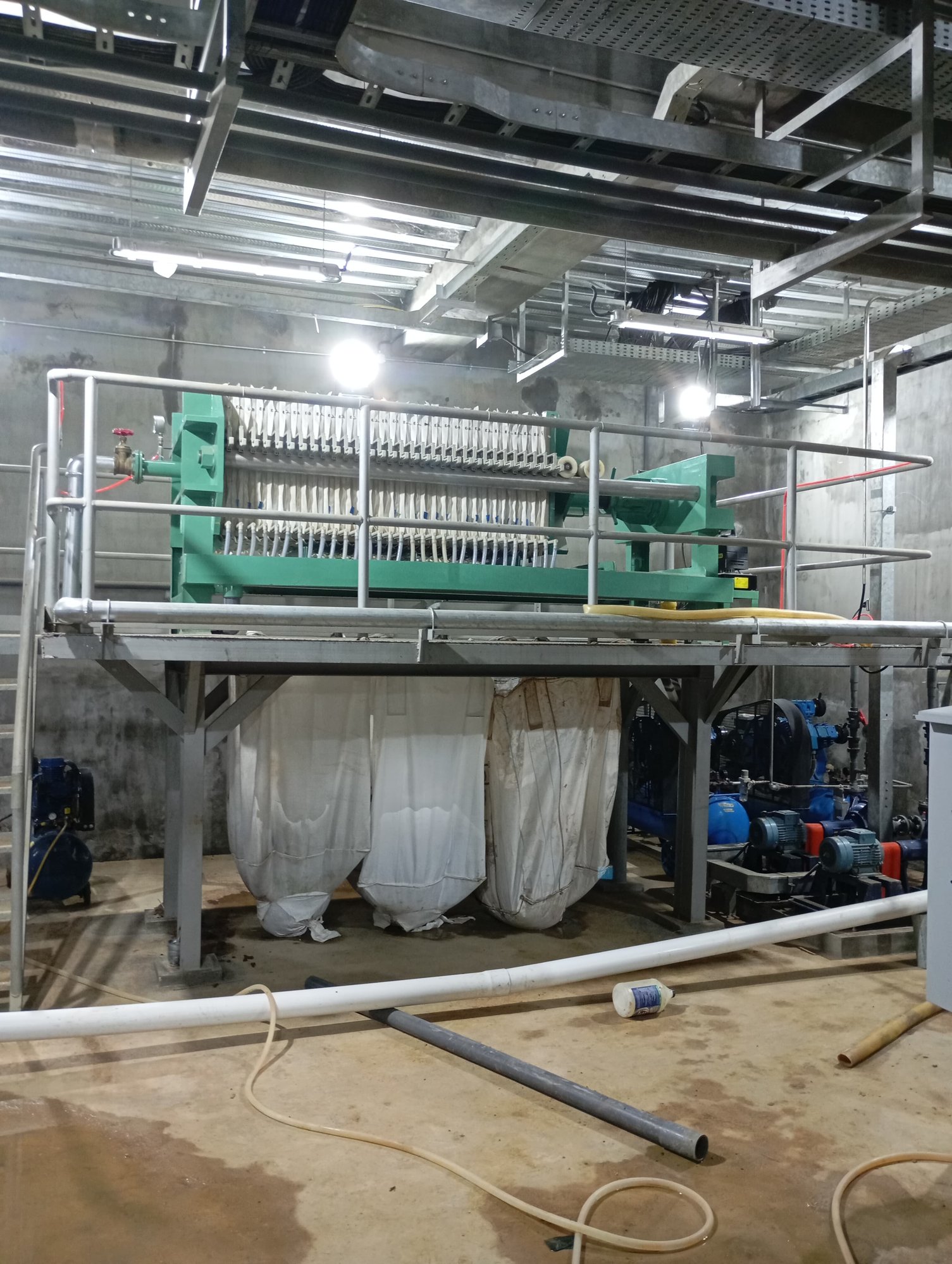
An industrial filter press removes water from sludge in a batch between plates and filter cloths. Select a chamber or membrane press from actual-sludge testing, cake and filtrate targets, volume per cycle, complete cycle time, conditioning, operating hours, utilities, and the routes for cake and wash water.
PT Beta Pramesti Asia, through beta.co.id, supplies Betaqua Engineered Filter Press units, sludge review, feed-pump and conditioning integration, installation, commissioning, training, and acceptance testing for industrial wastewater physical separation in Indonesia.
Technically reviewed: 1 August 2026.
Select a chamber or membrane filter press for the dewatering target
A chamber filter press suits reliable liquid-solid separation with automatic cloth washing. A membrane filter press adds a squeezing stage after filling and can be considered where the project needs further liquid removal from the cake. The data below shows each model’s cycle volume and filtration area; sludge data and operating targets are needed before selecting the configuration.
| Decision | Chamber filter press | Membrane filter press | Evidence to compare |
|---|---|---|---|
| Final mechanism | Filtration ends at the defined filling/pressure endpoint | A membrane squeeze adds a pressing stage after filling | Actual sequence, pressure, time, and filtrate curve |
| Cake target | Suitable where testing meets solids and handling criteria | Evaluated where squeeze produces measurable benefit | Cake solids, consistency, release, and destination |
| Capacity | Determined by chamber volume and completed cycles | Determined by volume, squeeze, and complete cycle time | Sludge volume, feed solids, cycle time, downtime, and work hours |
| Utilities | Feed pump, hydraulics, air/water as configured, and cloth wash | Chamber duties plus the model-specific squeeze system | Power, water, air, drains, panel, and available utilities |
| Operation | Filling, cake discharge, washing, and inspection | The same duties plus squeeze control | Operators, guards/interlocks, access, housekeeping, and spares |
The U.S. EPA Fact Sheet—Recessed-Plate Filter Press explains that press capacity depends on plate/chamber number and size and that the process converts liquid residuals into cake. General performance figures are not a guarantee for industrial sludge; actual testing remains the selection basis.
What test data is required before model selection?
Testing should represent the range of solids, temperature, pH, oil, and other constituents that change filtration. Conditioning with coagulant, lime, or flocculant is applied only after its product, dose, mixing, and effects on filtrate and cake are demonstrated.
| Data | Record | Decision supported |
|---|---|---|
| Feed sludge | Source, volume, solids percentage, particle size, pH, temperature, oil, and batch variation | Pretreatment, cloth, pump, chamber volume, and test envelope |
| Conditioning | Product, concentration, dose per dry solids, mixing, time, and cost | Filterability, filtrate capture, cake release, and cost per batch |
| Cycle | Fill time, pressure/flow, filtrate versus time, squeeze, core blow, open/close, discharge, and wash | Actual cycle time and cycles per shift/day |
| Outputs | Cake volume, solids percentage, filtrate TSS/turbidity, carryover, moisture, and release | Cake acceptance, filtrate route, disposal, and cleaning need |
| Reliability | Cloth blinding, leakage, plate alignment, alarms, downtime, and operator intervention | Spares, automation, maintainability, and available capacity |
As an initial check, cycles per day = wet-sludge volume per day ÷ proven feed volume per cycle. Correct the result for work hours, complete cycle time, downtime, and capacity with one unit offline. Catalogue chamber volume is not guaranteed sludge throughput.
| BFP (Automatic Chamber Filter Press With Cloth Washing System) | ||||
| Plate Size (mm) | Model | Pieces | Volume (L/Cycle) | Filter Area (m2/Cycle) |
| 800 X 65 T | BFP-800-20 | 20 | 304 | 20.9 |
| BFP-800-25 | 25 | 384 | 26.4 | |
| BFP-800-30 | 30 | 464 | 31.9 | |
| BFP-800-35 | 35 | 544 | 37.4 | |
| BFP-800-40 | 40 | 624 | 42.9 | |
| BFP-800-50 | 50 | 784 | 53.9 | |
| BFP-800-60 | 60 | 944 | 64.9 | |
| 1000 X 65 T | BFP-1000-40 | 40 | 1053 | 66.3 |
| BFP-1000-50 | 50 | 1323 | 83.3 | |
| BFP-1000-60 | 60 | 1593 | 100.3 | |
| BFP-1000-70 | 70 | 1863 | 117.3 | |
| BFP-1000-80 | 80 | 2133 | 134.3 | |
| 1200 X 68 T | BFP-1200-60 | 60 | 2360 | 147.5 |
| BFP-1200-70 | 70 | 2760 | 172.5 | |
| BFP-1200-80 | 80 | 3160 | 197.5 | |
| 1500 X 80 T | BFP-1500-60 | 60 | 3835 | 224.2 |
| BFP-1500-70 | 70 | 4485 | 262.2 | |
| BFP-1500-80 | 80 | 5135 | 300.2 | |
| 2000 X 80 T | BFP-2000-60 | 60 | 7021 | 407.1 |
| BFP-2000-70 | 70 | 8211 | 476.1 | |
| BFP-2000-80 | 80 | 9401 | 545.1 |
Automatic membrane filter press models
Prepare the sludge type, flow or batch volume, feed solids, filtrate target, cake target, and operating hours. The Beta Pramesti team can review these with the upstream and downstream sludge-treatment process so the filter press, thickening, and cake handling are assessed as one system.
| BFP (Automatic Membrane Filter Press) | ||||
| Plate Size (mm) | Model | Pieces | Volume (L/Cycle) | Filter Area (m2/Cycle) |
| 800 X 65 T | BFP-800-21 | 21 | 320 | 22.0 |
| BFP-800-25 | 25 | 384 | 26.4 | |
| BFP-800-31 | 31 | 480 | 33.0 | |
| BFP-800-35 | 35 | 544 | 37.4 | |
| BFP-800-41 | 41 | 640 | 44.0 | |
| BFP-800-51 | 51 | 800 | 55.0 | |
| BFP-800-61 | 61 | 960 | 66.0 | |
| 1000 X 65 T | BFP-1000-41 | 41 | 1080 | 68.0 |
| BFP-1000-51 | 51 | 1350 | 85.0 | |
| BFP-1000-61 | 61 | 1620 | 102 | |
| BFP-1000-71 | 71 | 1890 | 119 | |
| BFP-1000-80 | 81 | 2160 | 136 | |
| 1200 X 68 T | BFP-1200-61 | 61 | 2400 | 1450 |
| BFP-1200-71 | 71 | 2800 | 175 | |
| BFP-1200-81 | 81 | 3200 | 200 | |
| 1500 X 80 T | BFP-1500-61 | 61 | 3900 | 228 |
| BFP-1500-71 | 71 | 4550 | 266 | |
| BFP-1500-81 | 81 | 5200 | 304 | |
| 2000 X 80 T | BFP-2000-61 | 61 | 7140 | 414 |
| BFP-2000-71 | 71 | 8330 | 483 | |
| BFP-2000-81 | 81 | 9520 | 552 |
The model, cycle-volume, and filtration-area data in this table supports initial screening. Request the current datasheet and quotation revision before fixing capacity because plate configuration, accessories, pressure, and supply scope can differ.
How is a filter press accepted at commissioning?
Acceptance should prove capacity and quality on the agreed sludge and loading range. A clean-water test only checks leakage and mechanical function; it does not prove conditioning, cycle time, cake, or filtrate performance.
| Acceptance gate | Minimum evidence | Decision |
|---|---|---|
| Ready for sludge | Alignment, plates/cloths, guards, hydraulics, feed, valves, instruments, interlocks, drains, and SOP | Permit wet commissioning or hold for correction |
| Cycle can run | Feed batch, conditioning, pressure/flow trend, filtrate curve, alarms, cake discharge, and cloth wash | Establish setpoints and operating limits |
| Performance accepted | Feed solids, volume, cycle time, cake solids, filtrate quality, consumption, downtime, and cycles completed | Accept, conditionally accept, or repeat after correction |
For a feed or filtrate-transfer pump, review Watermart industrial pumps. For chemical conditioning, verify dosing-pump materials and actual output with the working solution.
Frequently asked questions about industrial filter presses
Does a membrane filter press always produce a drier cake?
Not automatically. Squeeze benefit depends on sludge character and conditioning, pressure, time, cloth, and endpoint. Compare chamber and membrane results on the same sample and criteria.
Does chamber volume equal daily capacity?
No. Daily capacity also depends on actual feed volume per cycle, complete cycle time, solids percentage, work hours, cleaning, downtime, and the operator’s ability to release cake.
What data is needed for a quotation?
Send the sludge source and variation, daily/batch volume, solids percentage, pH, temperature, oil/special constituents, conditioning/dewatering results, cake/filtrate targets, operating hours, utilities, layout, and residual route through the wastewater-treatment contact page.