

physical separation
Sludge Dewatering Screw Press | Beta Pramesti Asia
Sludge dewatering screw press chosen by dry-solids load, sludge tests, polymer response, cake targets, filtrate quality, utilities, and disposal plan.
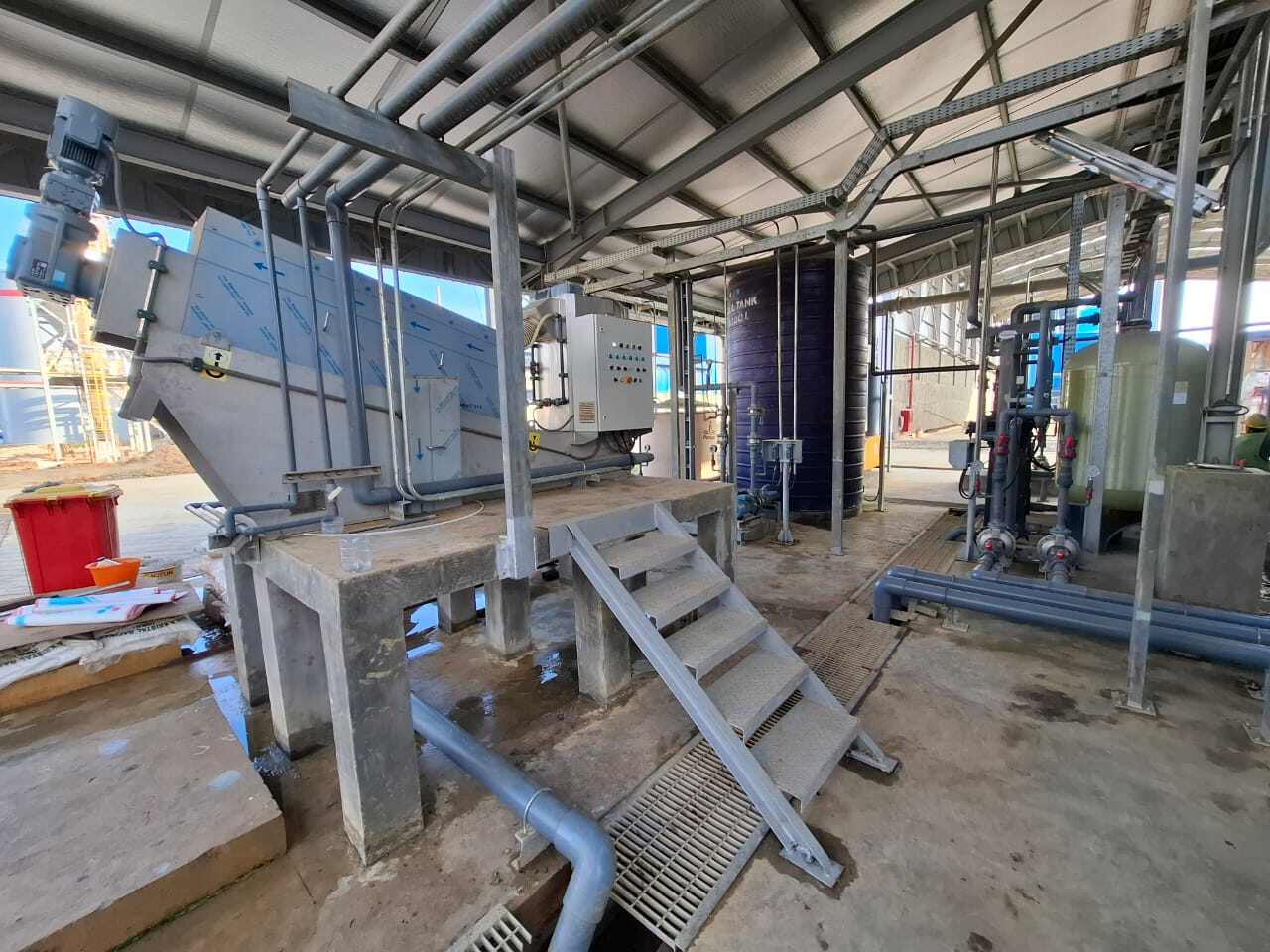
A sludge dewatering screw press separates water from conditioned sludge by moving floc through filtration and compression zones. Select the unit from feed rate, solids percentage, sludge type, polymer-test results, cake and filtrate targets, operating hours, and the disposal route—not screw diameter or total wastewater flow alone.
PT Beta Pramesti Asia, through beta.co.id, supplies Betaqua screw presses and dewatering-integration support for industrial wastewater plants in Indonesia. Evaluation covers the feed tank, polymer preparation, pumps, mixer, press, wash water, filtrate, cake handling, instrumentation, and operator safety.
Technically reviewed: 4 August 2026.
Which data determine the screw-press model?
Calculate dry-solids load before comparing models: sludge flow (m³/day) × feed solids (kg/m³) = kg dry solids/day. Two streams with the same volume may need different units and operating hours when concentration, thickening behaviour, or cake targets differ.
| Selection data | Why it matters | Decision supported |
|---|---|---|
| Normal/peak flow and operating hours | Defines the hourly load and buffer requirement | Model, train count, and feed-tank capacity |
| Solids percentage and sludge type | Separates biological, chemical, mineral, and oily sludges | Screw-press suitability and conditioning need |
| Polymer test | Assesses floc formation, filtrate, and cake | Flocculant, starting dose, and make-down system |
| Cake and filtrate targets | Defines dewatering and the return load to the WWTP | Unit settings, recycle route, and disposal cost |
| Abrasion, oil, fibres, and pH | Affects the screen, materials, cleaning, and wear | Materials, pretreatment, and inspection schedule |
| Wash water, power, space, and access | Determines whether the package can be run and maintained | Layout, utilities, platforms, and cake handling |
Before purchase, run a bench or pilot test on the actual sludge where practical. Record polymer-dose basis, feed rate, feed solids, cake solids, filtrate quality, wash-water use, torque stability, and screen condition. One sample is insufficient where the process load changes by shift or season.
How do polymer preparation and operation affect dewatering?
Polymer should form floc strong enough to pass through pumps and mixing without blinding the screen. Overdosing can increase cost, make filtrate slippery or cloudy, and leave residual polymer; underdosing can produce fine floc, solids carryover, and an unstable cake.
- Verify stock concentration, make-down water, addition sequence, and hydration time.
- Calibrate polymer and sludge-feed pumps under actual conditions.
- Start from the test result and change one primary variable at a time.
- Record feed rate, torque, filtrate, cake, wash water, and polymer consumption.
- Return filtrate to a WWTP point that can accept its hydraulic and solids load.
For a complete programme, align the press with industrial sludge treatment, coagulation, and the sludge generated by DAF. Feed equipment can be reviewed through Watermart dosing pumps for water treatment.
Betaqua screw-press model specifications
| Model | Discharge Height (mm) | Total Dimension (mm) | N.W (Kg) | Operating Weight (Kg) | Power (Kw) | Water Consumption (L/H) | ||
| L | W | H | ||||||
| Betaqua-131 | 250 | 1860 | 750 | 1080 | 2805 | 300 | 0.2 | 24 |
| Betaqua-132 | 250 | 1960 | 870 | 1080 | 275 | 425 | 0.3 | 48 |
| Betaqua-201 | 350 | 2440 | 860 | 1380 | 320 | 470 | 0.74 | 32 |
| Betaqua-202 | 495 | 2650 | 960 | 1380 | 470 | 730 | 1.11 | 64 |
| Betaqua-301 | 495 | 3370 | 940 | 1670 | 910 | 1320 | 1.5 | 40 |
| Betaqua-302 | 585 | 3570 | 1260 | 1670 | 1350 | 2130 | 2.25 | 80 |
| Betaqua-303 | 585 | 3830 | 1620 | 1670 | 1820 | 2880 | 3 | 120 |
| Betaqua-351 | 585 | 3900 | 1160 | 2190 | 1610 | 2210 | 1.1 | 72 |
| Betaqua-352 | 585 | 4240 | 1550 | 2190 | 2300 | 3400 | 2.75 | 144 |
| Betaqua-353 | 585 | 4460 | 2100 | 2190 | 3350 | 4850 | 3.85 | 216 |
| Betaqua-354 | 585 | 4660 | 2650 | 2190 | 4500 | 6100 | 4.95 | 288 |
| Betaqua-401 | 759 | 4356 | 1170 | 2400 | 2500 | 3400 | 1.85 | 80 |
| Betaqua-402 | 759 | 4900 | 1640 | 2400 | 3480 | 5200 | 2.95 | 160 |
| Betaqua-403 | 759 | 5030 | 2240 | 2400 | 4550 | 7050 | 4.05 | 240 |
| Betaqua-404 | 759 | 5350 | 3240 | 2400 | 6550 | 9660 | 5.15 | 320 |
The table is the product data currently published on this page, not a guaranteed process capacity. Request the latest model sheet and confirm every dimension, weight, power value, water requirement, solids capacity, and material before foundation design or purchase.
Capacity and operating-hours worksheet
Screw-press capacity should be fixed on kg of dry solids per hour and the operating hours available. This calculation prevents undersizing when a unit is selected only from daily sludge volume.
| Step | Formula or evidence | Example decision |
|---|---|---|
| Daily solids load | Sludge flow × solids percent × 1,000 kg/m³ | 20 m³/day × 2% = 400 kg DS/day |
| Hourly load | kg DS/day ÷ effective operating hours | 400 ÷ 8 hours = 50 kg DS/hour |
| Operating margin | Peak load, wash downtime, sludge variation, and standby | Select a model/train that still handles the peak case |
| Utilities | Wash water, power, instrument air where used, drain, and cake-handling space | Confirm utilities before the PO is issued |
| Trial acceptance | Cake solids, filtrate TSS, capture rate, polymer use, torque, and wash water | Accept the model only when all targets are met together, not from one number |
Document the acceptance run under the same operating-hours basis planned for production. If the test is short, separate start-up results from stable results so capacity is not read too optimistically.
| Operating-trial record | Minimum data | Acceptance or rejection reason |
|---|---|---|
| Inlet load | m³/h, solids percent, kg DS/h, and sample variation | Shows the model was tested at design load, not only at low flow |
| Cake output | solids percent, ton/day, discharge behaviour, and handling route | Confirms the disposal or haulage target can be met |
| Filtrate and recycle | filtrate TSS, return flow, and WWTP return point | Prevents return load from upsetting the biological or upstream DAF process |
| Supporting consumption | kg polymer/ton DS, L wash water/h, kWh, and wash hours | Calculates operating cost on the same basis as the offer |
| Mechanical stability | torque, alarms, screen condition, noise/vibration, and discharge inspection | Rejects settings that work briefly but are unstable for routine operation |
If operating hours are reduced, hourly capacity must rise even when daily solids load is unchanged. For projects with unstable sludge production, plan feed buffering and the filtrate recycle route so the biological wastewater programme does not receive a sudden return load.
What should be checked when screw-press performance is unstable?
| Symptom | First checks | Evaluation response |
|---|---|---|
| Cloudy filtrate | Floc, polymer dose, shear, screen condition, and feed rate | Restore conditioning and screen cleanliness before raising dose |
| Cake is too wet | Feed solids, compression setting, polymer, and operating hours | Compare performance with the test and mechanical limits |
| High torque | Flow, solids, foreign material, screen, and discharge route | Reduce load safely, then inspect for obstruction or wear |
| Polymer use increases | Make-down, calibration, sludge change, and injection point | Verify delivery and obtain a new sample before changing grade |
| Excessive wash water | Nozzles, pressure, wash schedule, and screen condition | Adjust cleaning from inspection and filtrate evidence |
Frequently asked questions about sludge screw presses
Can the model be selected from daily wastewater flow?
No. A screw press receives sludge, so selection requires sludge flow, solids concentration, dry-solids load, operating hours, conditioning results, and cake or filtrate targets.
Does a screw press always require polymer?
Need depends on sludge type and test results. Many sludges require conditioning so floc is retained, but product and dose should not be assumed without testing.
Which data are needed for an evaluation?
Send the sludge source, normal or peak flow, solids percentage, polymer-test results, cake and filtrate targets, operating hours, utilities, space, cake-handling method, and upset history through the Beta contact page.