

membrane
Industrial Membrane System Selection | Beta Pramesti
Select industrial UF, NF, BWRO, or SWRO from feed data, product targets, fouling risk, chemical needs, and verified commissioning evidence for site acceptance.
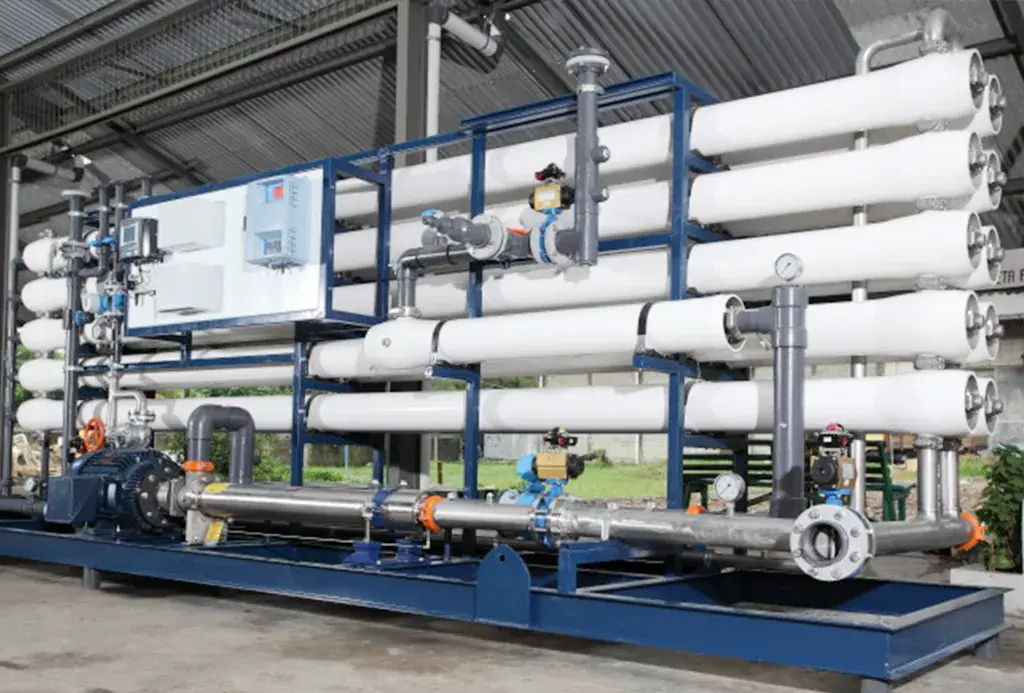
An industrial membrane system should be selected from feed-water quality, product-water targets, flow, recovery, fouling risk, and membrane operating limits—not capacity alone. A procurement-ready package also defines pretreatment, antiscalant or dechlorination needs, CIP provisions, instrumentation, and verifiable commissioning criteria.
PT Beta Pramesti Asia is an Indonesian water and wastewater treatment engineering company that designs, supplies, and supports UF, NF, BWRO, SWRO, and rental systems. This page was technically reviewed on 2 August 2026.
Which membrane system fits the plant duty?
The first decision follows the contaminants to be separated and the product quality to be achieved. Representative water testing and seasonal variation data are still required before fixing the membrane type, train count, recovery, and pretreatment.
| Buyer requirement | Option to evaluate | Design evidence to request |
|---|---|---|
| Retain fine solids and colloids ahead of RO | Ultrafiltration (UF) | Design flux, TMP, backwash/CEB sequence, filtrate quality |
| Reduce hardness, colour, or selected multivalent ions | Nanofiltration (NF) | Water analysis, membrane projection, rejection by ion, recovery |
| Produce low-salinity water from brackish feed | Brackish Water RO (BWRO) | Projection at feed temperatures, pressure, recovery, permeate quality |
| Desalinate seawater | Sea Water RO (SWRO) | Intake data, pretreatment design, projection, energy, post-treatment |
| Cover a trial, temporary demand, or emergency | Rental UF/RO unit | Feed limits, net capacity, utility interfaces, mobilisation plan |
The U.S. EPA membrane guide explains that process selection must address feed characteristics, pretreatment, fouling, cleaning, and residual disposal. The February 2026 DuPont FilmTec technical manual similarly treats system projection, pretreatment, operation, cleaning, and shutdown as connected decisions. See the U.S. EPA membrane filtration guide and 2026 DuPont FilmTec RO/NF manual.
What minimum data belongs in a membrane-system RFQ?
A useful RFQ separates normal, minimum, and worst-case design conditions. One laboratory result without a date, sampling location, or operating context is not a sufficient design basis.
| Data group | Minimum input | Why it affects selection |
|---|---|---|
| Capacity | Average and peak product flow, operating hours, redundancy requirement | Determines train count, turndown, and storage |
| Feed quality | TDS/conductivity, full ions, pH, temperature, turbidity, SDI if available, TOC/COD, iron, manganese, silica, microbiology | Determines pretreatment, scaling projection, and fouling risk |
| Product target | Conductivity or component limits and intended use | Determines membrane type, pass count, and post-treatment |
| Site constraints | Footprint, power, chemical handling, flushing water, drain, maintenance access | Determines layout and operability |
| Residuals | Concentrate, backwash water, and CIP-waste route | Determines integration with waste-treatment facilities |
| Operating pattern | Continuous/intermittent use, planned shutdowns, source changes | Determines controls, preservation, and standby strategy |
What belongs in the chemical-readiness handover?
A chemical-readiness handover confirms that chemicals, materials, injection points, interlocks, and procedures fit the membrane limits. The final dose must not be copied from another plant; it follows feed analysis, projection work, supplier data, and field validation.
| Function | Engineering decision | Evidence before start-up |
|---|---|---|
| Scaling control | Select a membrane antiscalant from ion projection and recovery | Projection file, initial dose, dosing-pump setpoint range |
| Oxidant protection | Evaluate a dechlorination agent and membrane compatibility | Injection point, residual analyser/test, alarm/interlock |
| Cleaning | Define the sequence and RO cleaning chemicals from foulant evidence and OEM limits | Material compatibility, CIP procedure, drain/neutralisation route |
| Dosing | Match dosing-pump capacity to feed flow and turndown | Stroke/output calibration, bunding, flow permissive |
| Monitoring | Establish baselines and RO/UF performance monitoring | Tag list, logging interval, normalised-data calculation |
How should membrane-system commissioning be accepted?
Commissioning is accepted after installation integrity, control functions, water quality, and hydraulic performance are demonstrated under recorded conditions. Design values and tolerances belong in the RFQ because membrane models, temperature, and feed quality vary by project.
| Hold point | Check | Acceptance record |
|---|---|---|
| Before wet testing | Materials, flow direction, cartridges, valves, instruments, flushing, drains | Signed checklist and critical punch items closed |
| Interlock test | Low/high pressure, tank level, dosing flow, pump trip, alarms | Cause-and-effect tested without hidden bypasses |
| Start-up | Ramp pressure/flow to OEM procedure and discharge preservative safely | Time, pressure, flow, pH, and conductivity recorded |
| Performance run | Feed, permeate, concentrate, temperature, pressure, flow, recovery, product quality | Compared with the projection at actual conditions |
| Handover | Procedures, baseline data, spares, training, cleaning/shutdown plan | Final revised documents accepted by operations |
Do not use one permeate-flow reading as the only proof. Record differential pressure, salt passage or rejection, recovery, temperature, and feed condition so that actual performance change can be separated from changing operating conditions.
What does Beta Pramesti supply and support?
- Site survey, water-data review, and pilot work or testing when needed
- UF, NF, BWRO, SWRO, skid-mounted, or containerised system design and supply
- Pretreatment, post-treatment, chemical dosing, and instrumentation integration
- Installation, commissioning, operator training, and handover documentation
- Monitoring, troubleshooting, CIP, membrane replacement, and spare-parts support
- Rental units for trials, temporary projects, maintenance shutdowns, or emergencies
For membrane hardware and related components, review Watermart reverse-osmosis systems. For an integrated engineering and chemical programme, contact Beta Pramesti with feed data, capacity, and product-water targets.
Industrial membrane-system FAQ
Is UF always required before RO?
No. UF need depends on the source, turbidity and colloid variability, biological risk, other pretreatment, and the RO operating objective. Compare fouling risk, footprint, backwash water, chemical cleaning, and life-cycle cost.
How should a buyer choose between NF and RO?
Start with the species to be removed and the product target. NF may fit hardness, colour, or selected multivalent-ion removal; RO is evaluated when broader dissolved-salt reduction is required. Confirm the choice using complete ion analysis and a membrane projection.
When is the antiscalant design fixed?
After feed-ion analysis, temperature, pH, recovery, and train configuration are available. Put the initial dose in the commissioning documents, then verify dosing calibration, operating data, and performance trends.
What proof should be requested before buying an RO unit?
Request the design basis, projection file, membrane and pump datasheets, P&ID, instrument/interlock list, utility demand, pretreatment and CIP scheme, performance-test criteria, and handover format. These items make vendor offers comparable.
How should a membrane system be prepared for shutdown?
Follow the membrane OEM procedure for flushing, cleaning when required, isolation, preservation, inspection, and restart. Shutdown duration, membrane type, fouling condition, temperature, and chemical compatibility determine the procedure; one preservation recipe does not fit every system.