

ancillaries
Industrial FRP Sand Filter Systems | Beta Pramesti Asia
Industrial FRP sand filters with automatic backwash. Compare flow, pressure, media, water quality, utilities, control and quotation data in Indonesia.
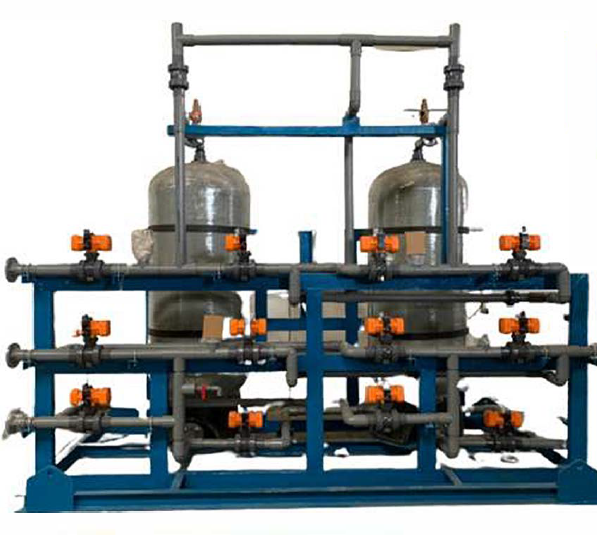
Industrial FRP sand filters start with water quality and solids load
Betaqua AFF industrial FRP sand filters are automatic pressure filters that retain solids according to the media arrangement and design conditions. Product data on this page covers flows of 0.3-126.4 m³/h; vessel size, media type and depth, pressure, backwash, and controls must follow the water analysis, filtrate target, peak flow, and site utilities.
PT Beta Pramesti Asia supplies the AFF series for automatic FRP configurations and the MSF series for manual steel vessels. The vessel only contains the process: filtration results depend on media type and depth, loading, pretreatment, filtration rate, backwash pattern, and actual water conditions. The Irish EPA filtration manual also treats operation, maintenance, and supervision as part of filter performance.
Technically reviewed: 31 July 2026.
When should the vessel use sand, multimedia, carbon, or resin?
A sand filter does not replace every other media duty. Use the water analysis and downstream process target to decide whether the vessel should contain sand alone, multimedia, activated carbon, specialist media, or ion-exchange resin.
| Problem or target | Configuration to evaluate | Evidence required |
|---|---|---|
| Turbidity and suspended solids | Sand or anthracite multimedia | Particle-size distribution, loading, filtrate quality, filter-run length, and backwash demand |
| Rapidly changing solids load | Multimedia, equalisation, coagulation, or other pretreatment | Peak-load response and available backwash capacity |
| Selected colour, odour, or organic compounds | Activated carbon after contaminant characterisation | Capacity, contact time, breakthrough, and replacement plan |
| Dissolved iron or manganese | Oxidation and suitable media | Contaminant form, pH, oxidant demand, and outlet quality |
| Hardness or dissolved ions | Ion-exchange resin, not sand alone | Ionic load, resin capacity, regeneration, and product-water quality |
Should the project use an AFF FRP or MSF steel media filter?
Select vessel material and controls after defining pressure, flow, water quality, media, corrosive environment, and operator capability. AFF prioritises an FRP vessel and automatic backwash; MSF provides steel construction with manual operation and a different capacity range. Compare models at the required operating point, not by vessel diameter alone.
| Criterion | AFF: automatic fibreglass filter | MSF: manual steel filter |
|---|---|---|
| Vessel material | Fibreglass with polyethylene liner | Mild steel or stainless steel SS304/SS316 |
| Product flow range | 0.3-126.4 m³/h | 0.8-196.3 m³/h |
| Stated pressure | 10 bar for 8-36 inch sizes; 6 bar for 42-79 inch sizes | 4 bar; higher-pressure options require confirmation |
| Operation | Automatic timed backwash or regeneration | Manual operation; backwash or regeneration on demand |
| Stated standard instruments | Inlet/outlet pressure gauges and differential-pressure alarm | Inlet/outlet Bourdon pressure gauges |
| Selection question | Do FRP material, automation, and the selected size suit the pressure and environment? | Do steel material, coating, operator access, and frontal piping suit the site? |
For steel-vessel alternatives, compare Betaqua Mild Steel Media Filters and Betaqua Stainless Steel Media Filters.
Data to prepare for a media-filter quotation
| Buyer data | Minimum detail | Decision affected |
|---|---|---|
| Flow | Average, peak, operating hours, standby-train requirement, and expansion plan | Vessel count and size, loading, and series/parallel arrangement |
| Water analysis | Turbidity, TSS, iron, manganese, organic matter, pH, temperature, and application-specific parameters | Media type, pretreatment, target run time, and test requirement |
| Outlet target | Parameter limits after the filter and the next process duty | Media arrangement, stage count, cartridge polishing, or downstream process |
| Hydraulics | Inlet pressure, minimum downstream pressure, available headloss, and pump capacity | Vessel rating, valves, frontal piping, and backwash feasibility |
| Backwash utilities | Water source, flow/pressure, tank, drain, duration, and discharge constraints | Backwash-line size, sequence, and waste-water storage |
| Site conditions | Indoor/outdoor, temperature, UV exposure, salinity, nearby chemicals, space, and service access | Material, coating, skid, protection, and layout |
| Controls | Timer, differential pressure, remote signal, interlocks, and panel integration | Automatic valves, transmitters, alarms, and panel scope |
Send the water analysis, target, and hydraulic data through the Beta contact page. Where the main requirement is selecting the media fill, Watermart’s water-filtration media page provides the component-selection step in the buyer journey.
Betaqua Automatic Fiberglass Filters (AFF Series)
AFF uses fibreglass vessels with polyethylene liners and automatic operation. Stated media configurations include anthracite, Zeosand, sand, activated carbon, and anion or cation ion-exchange resin. Final media selection must follow the contaminant, outlet target, filtration rate, compatibility, and regeneration or replacement plan.
| AFF specification | Product data |
|---|---|
| Material | Fibreglass with polyethylene liner |
| Operating pressure | 10 bar for 8-36 inch sizes; 6 bar for 42-79 inch sizes |
| Flow | 0.3-126.4 m³/h |
| Standard operation | Timer for automatic backwash or regeneration |
| Piping and instruments | PVC frontal piping, differential-pressure alarm, inlet/outlet pressure gauges |
| Options | Remote operation, 4-20 mA pressure transmission, chlorine generator for softening duties, stainless- or mild-steel skid |
Betaqua Manual Steel Filters (MSF Series)
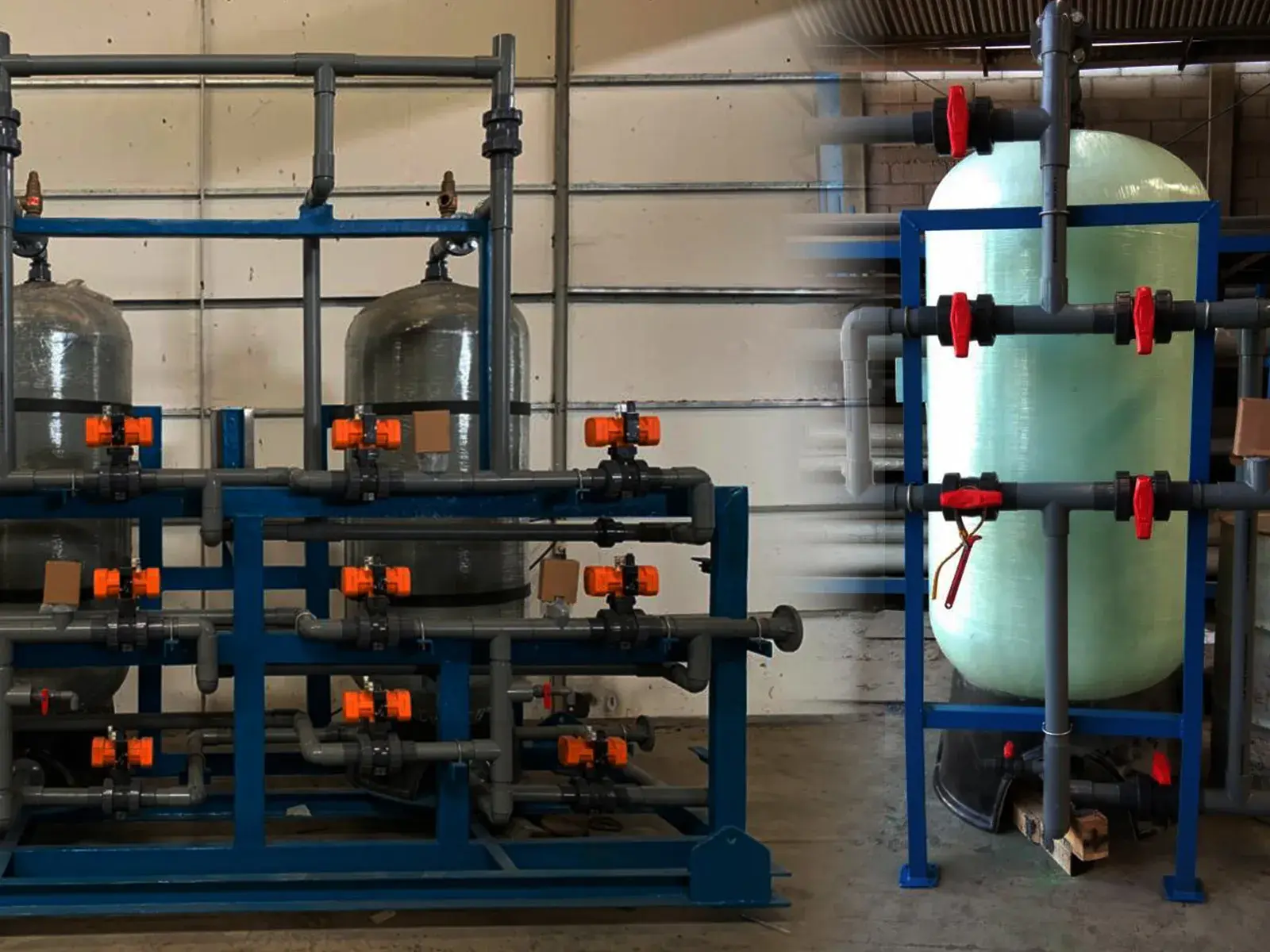
MSF is a manual-operation alternative using mild-steel or stainless-steel vessels. Product data states a 0.8-196.3 m³/h flow range, 4 bar operating pressure with higher-pressure options, PVC or stainless-steel frontal piping, and inlet/outlet pressure measurement. Final material and coating should follow the water and site environment.
How the filter runs and how acceptance is proven
- Water enters through the distributor and passes through the selected media arrangement.
- Inlet/outlet pressure, flow, and filtrate quality are monitored during the filter run.
- Backwash or regeneration starts at the agreed time, differential pressure, filtrate quality, or media-capacity limit.
- The filter returns to service after its rinse sequence and initial-water-quality criteria are satisfied.
Acceptance testing should record flow, starting/ending pressure, headloss, before/after water quality, filter-run duration, backwash flow and duration, and post-restart condition. To protect downstream equipment from finer particles, also evaluate a cartridge filter against the system target and arrangement.
FAQ
What does an FRP media filter do?
An FRP media filter is a pressure vessel that holds filtration media. Its treatment duty is determined by the media, water quality, filtration rate, pretreatment, and backwash; the FRP material itself is not the contaminant-removal medium.
Can one media type solve every water-quality problem?
No. Sand, anthracite, activated carbon, Zeosand, and resin have different duties and operating conditions. Selection must follow the water analysis, outlet target, compatibility, capacity, and backwash or regeneration plan.
When should AFF be selected instead of MSF?
AFF is worth evaluating when the project needs an FRP vessel and automatic backwash within the available model range. Compare MSF where steel construction, manual operation, another capacity range, or a specific fabrication requirement is more suitable.
What data matters most before requesting a quotation?
Prepare average/peak flow, water analysis, filtrate target, pressure, backwash utilities, site conditions, space, and control requirements. Without those facts, vessel diameter and media selection are only estimates.
Technical reference accessed 31 July 2026: EPA Water Treatment Manual—Filtration.