

ancillaries
What Is an Industrial Clarifier | Beta Pramesti Asia
An industrial clarifier settles TSS and floc for WTP or wastewater. Check flow, jar test, settling, sludge, blowdown, and measured acceptance evidence.
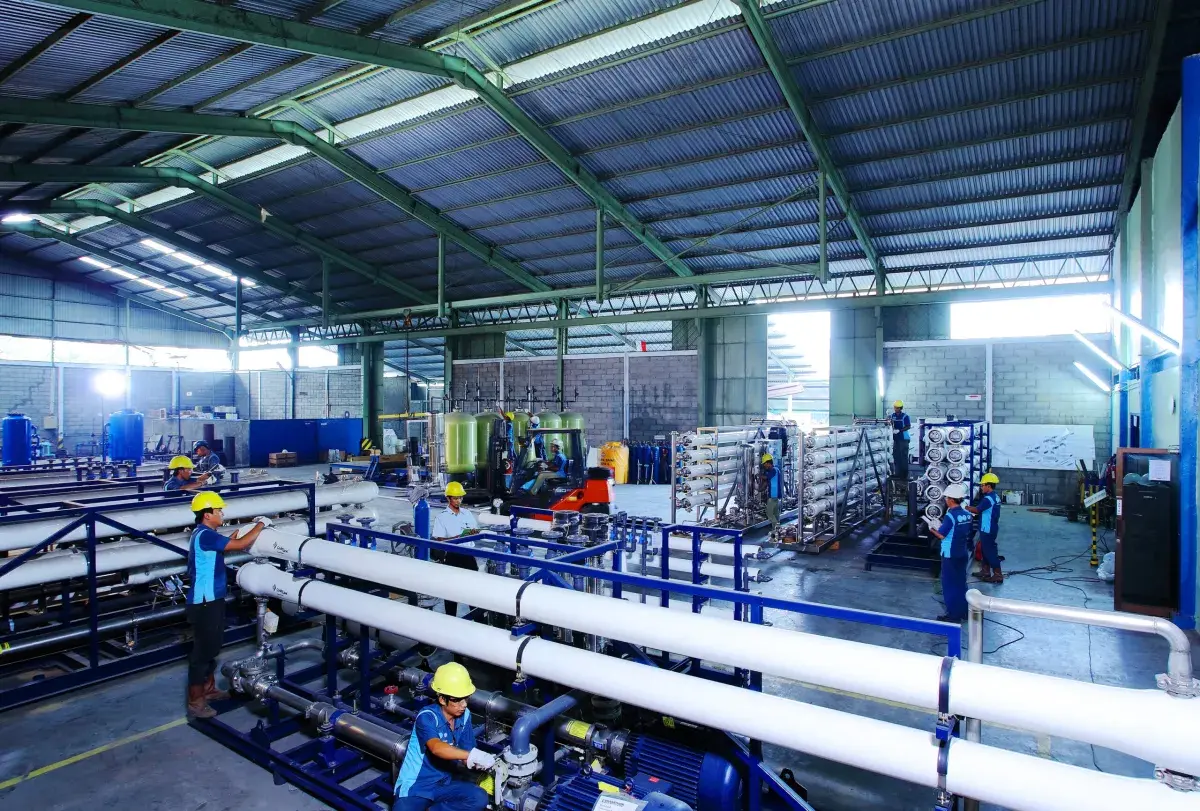
An industrial clarifier is a gravity-settling unit that separates TSS, turbidity, and conditioned floc from raw water, process water, or wastewater. PT Beta Pramesti Asia, through beta.co.id, supplies Betaqua clarifiers in Indonesia with verification of flow, TSS, jar testing, settling, blowdown, and sludge-route capacity before the unit is selected.
Technically reviewed: 4 August 2026.
Purify your water with our clarifier
Our clarifiers are designed for water clarification excellence. Our Circular Clarifier system, with a capacity of 50 m^3/hr, and the Rectangular Clarifier with a capacity of up to 80 m^3/hr, are both designed to efficiently reduce Total Suspended Solids (TSS) or turbidity through a gravity settling process. Whether for drinking water treatment or industrial wastewater management, Betaqua clarifiers offer solutions that are not only innovative but also reliable in ensuring water quality that meets environmental standards and the specific needs of our customers.
Advantages
BetaQua clarifiers integrate technical innovation with construction reliability. Each clarifier model is designed with features that enhance performance and ease operation. Our engineering expertise is reflected in the selection of materials and components, ensuring that every clarifier system operates with maximum efficiency and minimal downtime.
NEED THE BEST CLARIFIER?
Contact our team for a consultation on the Clarifier that suits your needs.
Betaqua Circular Clarifier Specifications
We offer various types of Betaqua Circular Clarifier that can be customized to your needs.
Circular Clarifier
The BetaQua Circular Clarifier offers high efficiency with a capacity of 50 m^3/hr, ideal for reducing Total Suspended Solids (TSS) or turbidity through a gravity settling process.
Applications
- Effluent Treatment Plant Primary Treatment
- Demin Water Pre-treatment
- Drinking/Potable Water Clarification
- Wastewater Treatment Secondary Treatment
- Mining Heavy Metal Removal
Standard Features
- Carbon Steel Tank with Epoxy Coating
- Sludge Scraper
- Ladder
- Nozzles and Weir
- Manual Isolation Valve for Drain/Blowdown
Operational Parameters
- Fiber/Rubber Lining for Internal Carbon Steel Tank
- SS304 Tank
- Pneumatic Isolation Valve for Drain/Blowdown
Rectangular Clarifier
The Betaqua Rectangular Clarifier is a lamella clarifier with a capacity of 80 m3/hr, maximizing TSS or turbidity reduction.
Applications
- Power Plant Boiler Feed Water Treatment
- Demin Water Pre-treatment
- Drinking/Potable Water Clarification
- Wastewater Primary Treatment
Standard Features
- Carbon Steel Tank with Epoxy Coating
- Sludge Scraper
- Ladder
- Nozzles and Weir
- Manual Isolation Valve for Drain/Blowdown
Optional Features
- Fiber/Rubber Lining for Internal Carbon Steel Tank
- SS304 Tank
- FRP Tube Settler/SS304 Lamella Plate Settler
- Pneumatic Isolation Valve for Drain/Blowdown
Betaqua Circular Clarifier Specifications
We offer various types of Betaqua Circular Clarifier that can be customized to your needs.
Learn More
Clarifier Selection Data and Solids Loading
A clarifier is selected from actual hydraulic and solids loading, not tank diameter or average flow alone. Calculate solids load as TSS (mg/L) × flow (m³/day) ÷ 1,000 = kg TSS/day, then test whether the solids form settleable floc in the real water. The result indicates whether clarification is sufficient, whether it needs coagulant and flocculant, or whether DAF should be evaluated for oil, grease or poorly settling floc.
| Design or operating data | Why it matters | Decision it supports |
|---|---|---|
| Average and peak flow | Establishes actual hydraulic loading and available retention time | Unit size, flow splitting and equalisation need. |
| TSS, turbidity, colour and oil/grease | Separates readily settling solids from loading that needs flotation or pretreatment | Clarifier suitability versus DAF or filtration. |
| Jar-test and settling results | Shows floc formation and supernatant clarity at a defined dose and pH | Coagulation-flocculation programme and injection-point selection. |
| Sludge character | Volume, thickening rate and dry-solids percentage | Hopper capacity, sludge withdrawal schedule and sludge treatment. |
| Treated-water target | Subsequent use, discharge limit or membrane pretreatment | Need for final filtration, ultrafiltration or another polishing step. |
For a Betaqua clarifier evaluation, send this data with a flow diagram and history of operating upsets through Beta’s contact page. The technical team can tie unit selection to chemistry testing and the sludge route, so capacity is not assessed from one flow figure alone.
Initial Gate: Clarifier, DAF, or Filtration?
A clarifier is appropriate when solids or conditioned floc settle consistently and the sludge route can receive the separated mass. Test the actual sample before choosing the mechanism: high TSS does not mean that every particle will settle readily.
| Evidence from the sample or existing unit | First route to test | Reason and next verification |
|---|---|---|
| Floc settles, supernatant remains stable, and oil/grease is not dominant | Gravity clarifier | Measure peak flow, settling rate, sludge volume and carryover. |
| Fine floc settles poorly or oil/grease must separate with the solids | DAF | Test flotation, recycle/air requirement, skimming and clarified-water quality. |
| Residual solids are low but the polishing target is tighter | Filtration or ultrafiltration after primary separation | Check particle size, fouling, backwash, recovery and product-water use. |
| No stable floc forms at the initial pH and dose | Optimise coagulants and flocculants before selecting the unit | Compare injection order, mixing, pH, dose and sludge volume through jar testing. |
| TDS, rather than TSS, limits water use | Dissolved-ion treatment, not a clarifier | Complete ion analysis and assess RO, demineralisation or ion exchange against the target. |
As a mass-balance check, a stream of 800 m³/day at 500 mg/L TSS carries 400 kg solids/day. If testing demonstrates 90% capture, the sludge route receives approximately 360 kg dry solids/day, while about 40 kg/day remains in the treated water. This does not define wet-sludge volume: measure dry-solids percentage or settled volume so the hopper, blowdown frequency, sludge tank and dewatering stage are not undersized.
Where the unit also needs chemical-injection hardware and water-treatment components, align the package with Watermart dosing pumps for water treatment. Set materials, flow range, pressure and standby duty from the test results and process diagram rather than the pipe connection alone.
Industrial clarifier FAQ
Can a clarifier solve every high-TSS problem?
No. A clarifier is effective for solids or floc that settle, but it is weaker for oil, grease, light floc, or very fine particles without conditioning. Settling and jar tests decide whether coagulant-flocculant, DAF, filtration, or another step is needed.
What commissioning evidence should be kept for a clarifier?
Keep actual flow, influent and effluent TSS, turbidity, sludge blanket, blowdown frequency, sludge volume, chemical dose where used, and photos or notes on carryover. This separates hydraulic, chemistry, and sludge-removal problems.
When should a clarifier be combined with filtration or UF?
Combination treatment is needed when clarified water still carries fine particles or the next use has a tighter target, such as RO pretreatment, reuse, or process water. Select polishing from particle size, SDI/turbidity, fouling risk, and backwash cost.