

specialty
RO Antiscalant: Scale Prevention | Beta Pramesti Asia
RO antiscalant prevents mineral scale when selected from feedwater ions, recovery, and concentrate risk. Compare dose, equipment, monitoring and cost.
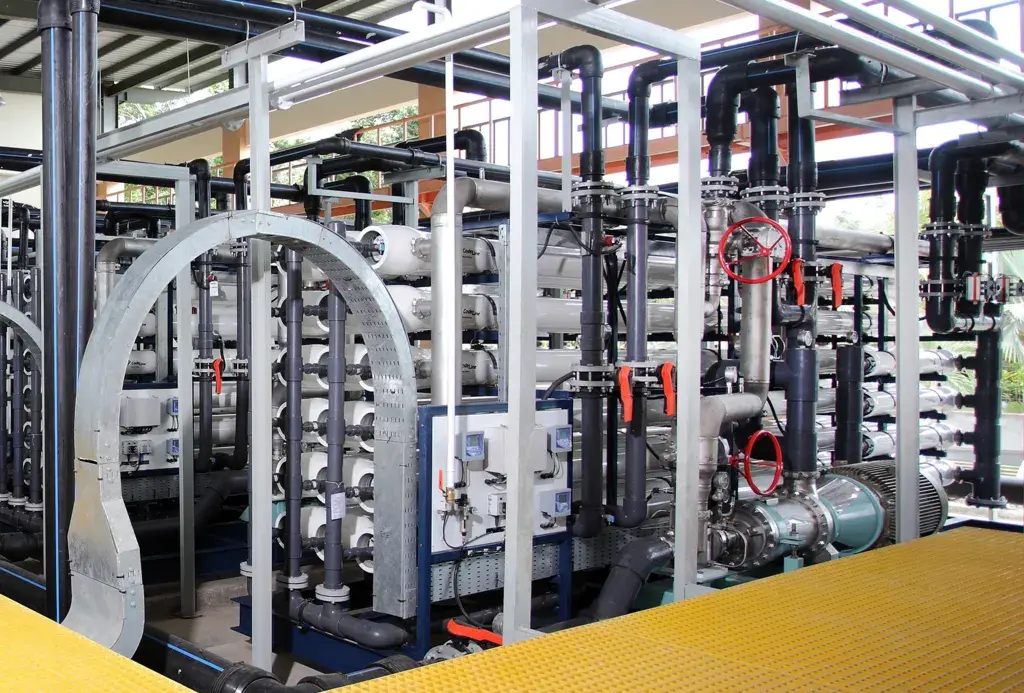
What is an RO antiscalant?
An RO antiscalant is a preventive chemical that delays mineral scale inside reverse-osmosis and nanofiltration systems. It must match the feed-water ions, temperature, pH, recovery, concentrate chemistry, membrane design, and operating limits; it does not remove scale-forming ions or correct particulate, organic, or biological fouling.
PT Beta Pramesti Asia supplies industrial RO antiscalant through a BETAGARD programme selected from feed-water analysis, recovery, and scale risk. A proposal should state the formulation, projected dose, daily demand, delivery volume, injection equipment, and monitoring support—not only a price per drum.
Technically reviewed: 5 August 2026.
Which RO membrane antiscalant matches the scaling risk?
The right membrane antiscalant is the formulation that keeps the limiting mineral below its precipitation risk at the actual concentrate chemistry. Selection starts with a complete feed-water analysis, the membrane configuration, temperature, pH, and target recovery—not a generic product label or dose range.
The February 2026 DuPont FilmTec RO/NF technical manual identifies carbonate, sulfate, fluoride, silica, and metal-related deposits as distinct risks. It also warns that some polymer antiscalants can be deactivated by iron or aluminium. DuPont’s WAVE scaling guidance calculates saturation risk but does not predict an antiscalant’s efficacy, so the chemical manufacturer must confirm the product and dose. For a buyer, this means a defensible proposal should show the feed analysis, concentrate projection at design recovery, compatibility basis, dosing calculation, and operating checks. PT Beta Pramesti Asia uses those inputs to assess the BETAGARD programme rather than treating all RO scaling as the same problem.
| Design condition | Data to verify | Selection decision |
|---|---|---|
| Carbonate scaling | Calcium hardness, alkalinity, pH, temperature, and concentrate LSI or S&DI | Check the projected saturation at design recovery and whether pH adjustment is also required |
| Calcium, barium, or strontium sulfate risk | Calcium, barium, strontium, sulfate, ionic strength, and recovery | Confirm the formulation’s stated sulfate-control range against the projected concentrate |
| Silica or aluminosilicate risk | Reactive silica, pH, temperature, aluminium, iron, and recovery | Review silica control and metal compatibility together; more polymer is not automatically the answer |
| High SDI, turbidity, iron, or aluminium carry-over | SDI, turbidity, metals, coagulant carry-over, and filter performance | Correct pretreatment first; antiscalant does not replace solids removal |
| Variable reuse or process-water feed | Analyses from representative operating conditions, not one sample | Set recovery and dose review triggers for the expected feed-water range |
How does antiscalant protect an RO membrane?
Membrane antiscalants delay mineral precipitation through threshold inhibition, crystal distortion, and dispersion. This can keep scale-forming ions in the concentrate stream long enough to leave the RO or NF train, but it does not remove those ions from the water and does not correct particulate, organic, or biological fouling.
Carbonate, sulfate, and silica deposits can restrict the feed spacer, raise pressure differential, reduce normalized permeate flow, and increase cleaning demand. When deposits already affect performance, identify the foulant before selecting industrial RO membrane cleaners; an antiscalant is preventive chemistry, not a substitute for a correctly designed CIP.
How should an antiscalant dose be set and verified?
Set the dose from the selected product’s recommendation and a scaling projection at the proposed recovery, then verify the physical feed rate and normalized membrane trend. Do not transfer a dose from another plant unless its feed chemistry, temperature, recovery, membrane train, and product concentration are genuinely comparable.
- Confirm the design basis. Record feed flow, recovery, temperature, membrane arrangement, permeate target, and the expected range of feed-water chemistry.
- Model the concentrate. Check carbonate, sulfate, silica, barium, strontium, and other limiting salts at the recovery under review.
- Confirm the product basis. State whether the recommended dose is neat product or active ingredient, plus product concentration, dilution water quality, compatibility, and injection point.
- Calibrate the feed equipment. Where dose is expressed as supplied product, daily demand in kg/day equals dose in mg/L multiplied by dosed flow in m³/h and 24, divided by 1,000. Convert mass to pump volume using the product density and actual dilution ratio. A calibrated chemical dosing pump should deliver that flow at operating backpressure.
- Trend the result. Compare pressure differential, normalized permeate flow, normalized salt passage, concentrate chemistry, pump calibration, tank consumption, and CIP findings against the agreed baseline.
Worked conversion from dose to pump setting
Calculate the pump setting from product as supplied, actual density, dilution ratio, and dosing hours. This example is illustrative, not a BETAGARD specification: a 3 mg/L dose into 50 m³/h of RO feed requires 3 × 50 × 24 ÷ 1,000 = 3.6 kg/day of product as supplied.
If the current batch document gives a density of 1.10 kg/L, neat-product demand is approximately 3.6 ÷ 1.10 = 3.27 L/day. At one volume of product plus nine volumes of compatible water, the dosing-solution volume is approximately 32.7 L/day. A pump operating for 24 hours has an initial setting of 32.7 ÷ 24 = 1.36 L/h; if dosing runs for only 20 hours, the mathematical setting becomes 1.64 L/h and must be interlocked with feed flow.
| Check | Expected result in the example | If the result does not agree |
|---|---|---|
| Neat-product use | About 3.27 L per 24 hours | Verify density, dose basis, tank level, and records of product additions |
| 1+9 solution use | About 32.7 L per 24 hours | Check dilution ratio, pump calibration, leakage, and any return/relief line |
| Eight-hour solution drawdown during 24-hour operation | About 10.9 L | Measure at operating backpressure; stroke/frequency settings without drawdown do not prove flow |
| RO train performance | Continues to be compared with the normalized baseline | If differential pressure or salt passage worsens, check fouling, instruments, and pretreatment rather than only increasing dose |
Use density, dilution stability, dilution-water quality, and concentration limits from the current product document. A two-way reconciliation—solution leaving the day tank and neat product leaving inventory—helps separate an incorrect pump setting from a mixing error or a change in RO feed flow.
What should operators do when recovery or reject conductivity changes?
A change in recovery, temperature, or reject conductivity changes the concentrate chemistry, so the previous antiscalant dose may no longer be valid. The right response is to close the operating balance, update the scaling projection, then check the dosing pump and membrane trends before raising dose or changing product.
| Observed change | Quick check | Defensible decision |
|---|---|---|
| Recovery is increased | Carbonate, sulphate, silica, barium, strontium projection, and membrane limits | Revise dose or reduce recovery if the limiting mineral exceeds the programme boundary |
| Reject conductivity rises | Conductivity-meter calibration, feed/reject flow, and feed-water quality | Separate normal concentration from scaling, valve leakage, or feed change |
| Differential pressure rises at the same time | SDI, cartridge filters, iron/aluminium, biofilm, and CIP deposit evidence | Do not only add antiscalant when evidence points to non-mineral fouling |
| Antiscalant consumption does not match calculation | Day-tank drawdown, density, dilution ratio, and flow interlock | Correct the feed system before changing the product recommendation |
What should an antiscalant price quotation include?
A useful proposal makes the technical and commercial basis auditable. Buyers should be able to compare products on the same feed-water case and annual demand, not only on price per drum.
| Proposal item | Evidence to request | Why it matters |
|---|---|---|
| Feed-water basis | Sample point, analysis date, laboratory results, temperature range, and operating variability | Prevents selection from an unrepresentative water sample |
| Design case | RO/NF capacity, membrane model, staging, recovery, concentrate projection, and limiting scale | Shows what the programme is expected to control |
| Chemical specification | Product data sheet, safety data sheet, recommended dose basis, dilution method, and compatibility statement | Allows operations and HSE teams to review the actual product |
| Dosing package | Tank volume and material, pump calibration range, injection point, interlock or flow signal, and spare strategy | Tests whether the calculated dose can be delivered consistently |
| Acceptance checks | Starting baseline, review frequency, alarm triggers, and named operating data | Separates chemical delivery from a monitored treatment programme |
| Commercial basis | Delivered product price, calculated kg/day, annual quantity, logistics, technical support, and change-control terms | Reveals installed programme cost instead of price per kilogram alone |
For a like-for-like comparison, calculate product cost per m³ feed = dose (mg/L) × delivered price per kg ÷ 1,000. If a vendor quotes active ingredient or a diluted feed solution, first normalize it to product as supplied. Add dosing, sampling, cleaning, and lost-production costs only where candidate scopes genuinely differ and supporting data are available.
If two proposals use different recoveries, cost per m³ of feed is not a complete comparison. Also calculate product cost per m³ permeate = cost per m³ feed ÷ recovery; at 75% recovery, for example, divide by 0.75. Use a recovery supported by the scaling projection and membrane operating limits, rather than raising it only to make the permeate-cost figure look lower.
Related RO chemical programmes
- Reverse osmosis chemicals and BETAGARD 6000 for the broader antiscalant, cleaning, biocide, and dechlorination programme.
- BETAGARD RO cleaning chemicals for diagnosis and chemical cleaning based on the suspected deposit and operating trend.
- Dechlorination agents to control free chlorine before oxidation-sensitive RO membranes.
- For membranes, cartridge filters, pressure vessels, and RO components, see Watermart’s RO membrane and component range.
Frequently asked questions
Can an antiscalant quotation begin before every data point is available?
It can begin by mapping data gaps and the evaluation scope, but product, dose, and performance expectations should not be fixed from hidden assumptions. Record missing parameters, arrange additional sampling or analysis, and revise the scaling projection before the final quotation.
Who supplies industrial RO membrane antiscalant in Indonesia?
PT Beta Pramesti Asia supplies membrane antiscalant and related BETAGARD RO chemical programmes for industrial facilities in Indonesia. Product selection and dose are reviewed against the site’s feed-water analysis, recovery, membrane configuration, dosing equipment, and operating targets before a proposal is issued.
Can antiscalant replace RO pretreatment?
No. Antiscalant controls specific mineral precipitation risks; it does not remove suspended solids, organic matter, microorganisms, iron carry-over, or oxidants. Filtration, SDI control, dechlorination, pH adjustment, and other pretreatment steps still need to meet the membrane design basis.
Is membrane antiscalant dosed before UF?
Antiscalant normally protects the high-recovery RO or NF step. In an integrated UF-to-RO train, the injection point should follow the process design, product compatibility, and membrane supplier guidance; it should not be assumed that dosing ahead of UF will solve UF fouling.
When should the antiscalant dose be reviewed?
Review it when feed-water chemistry or temperature changes, recovery increases, the dosing pump is recalibrated, pressure differential rises, normalized permeate flow falls, or the concentrate projection differs from the design basis. CIP inspection or deposit analysis may show that the problem is not mineral scale.
What should be verified when changing an RO antiscalant product?
Do not change products by copying the previous dose number. Recheck the water analysis, concentrate projection, dose basis as supplied, density, dilution stability and water quality, tank material, pump range, injection point, and compatibility with material left in the day tank or dosing line. The emptying, flushing, startup-feed, and post-change monitoring plan should follow both product documents and the site procedure.
How can low antiscalant dose be separated from pretreatment failure?
Low antiscalant dose usually matches a mineral scale risk shown in the concentrate projection, while pretreatment failure often appears with SDI/turbidity, iron, aluminium, or a fast pressure-differential rise. Check concentrate chemistry, pump calibration, day-tank level, SDI, cartridge filters, and deposit analysis before increasing dose.
What information does Beta need for a recommendation?
Send the feed-water analysis, RO or NF capacity, recovery, membrane model, pH, temperature, conductivity, hardness, alkalinity, silica, sulfate, barium, strontium, SDI, chlorine residual, flows, pressures, and CIP history through the Beta contact page.
Discuss an RO antiscalant programme
Contact PT Beta Pramesti Asia to compare an industrial membrane antiscalant programme against your feed-water analysis, recovery target, dosing equipment, and normalized operating data.