

ancillaries
Chemical Dosing Pump Selection | Beta Pramesti Asia
Select a chemical dosing pump from dose, concentration, process flow, backpressure, materials, turndown, interlocks, output calibration, and operating evidence.
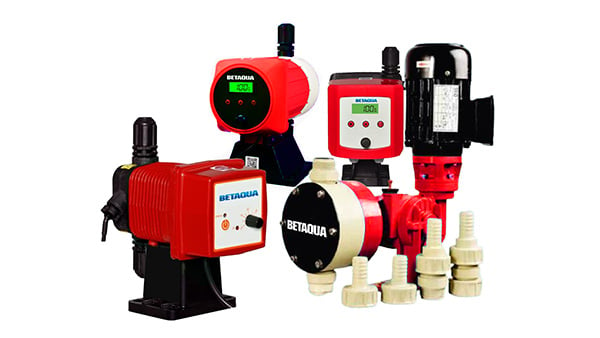
A chemical dosing pump is selected from required solution flow at minimum-to-peak process flow, actual backpressure, concentration, chemical properties, wetted materials, turndown, controls, and standby duty. Catalogue capacity does not prove dose: output must be calibrated using an approved fluid and method under the installed condition.
PT Beta Pramesti Asia, through beta.co.id, supplies Betaqua Dosing Pumps and integration support for water, wastewater, cooling-tower, boiler, reverse-osmosis, coagulant, flocculant, and other industrial chemical programmes in Indonesia.
Technically reviewed: 1 August 2026.
What chemical dosing-pump capacity is required?
Calculate an initial flow on a consistent concentration basis, then add the justified operating range and engineering margin. For solution concentration in g/L and commercial-product dose in mg/L:
Solution flow (L/h) = product dose (mg/L) × process flow (m³/h) ÷ solution concentration (g/L)
Example: a 5 mg/L product dose at 100 m³/h using a 50 g/L solution requires a theoretical 10 L/h. This does not yet account for purity/active basis, flow variation, density for mass-based calculation, turndown, pressure, pulsation, or duty/standby requirements.
| Selection input | Data to provide | Risk if omitted |
|---|---|---|
| Dose and chemical basis | mg/L as product or active, density, concentration, and dose range | Incorrect flow because active and commercial-product bases are mixed |
| Process flow | Minimum, normal, peak, batch, and flow-pacing signal | Pump cannot turn down or runs out of capacity |
| Injection hydraulics | Normal/peak pressure, elevation, pipe length, valves, and injection quill | Backflow, siphoning, excess pressure loss, or unstable dose |
| Chemistry and materials | Product, concentration, pH, temperature, viscosity, gassing, crystallisation, and SDS | Incompatible seals, head, diaphragm, tubing, or valves |
| Controls | Manual, pulse, analogue, batch, interval, interlock, alarms, and remote status | Dose does not follow the process or failure remains undetected |
| Reliability | Duty/standby, calibration, spares, access, bund, drain, and safety | Programme stops when the pump, suction, or tank fails |
Use the industrial dosing-pump sizing and calibration guide for a complete worksheet. For a broader component selection, review Watermart dosing pumps.
Which chemical programmes use dosing pumps?
The same pump is not automatically suitable for every chemical. Lock down the fluid, flow, pressure, materials, injection point, and interlocks for each programme.
| Buyer programme | Chemicals that may be metered under the design | Main control data |
|---|---|---|
| Cooling-tower treatment | Compatible corrosion/scale inhibitor, dispersant, or biocide | Make-up, blowdown, conductivity, residual, slug/continuous schedule, and circulation interlock |
| Boiler-water treatment | Oxygen scavenger, alkalinity control, phosphate/dispersant, or amine under the programme | Feedwater/steam load, tank, injection point, residual, and feed-pump status |
| Reverse-osmosis chemicals | Antiscalant, dechlorination agent, or another programme chemical within membrane limits | Feed flow, recovery, residual chlorine, pH, alarms, and RO permissive |
| Coagulation and flocculation | Coagulant and polymer solution compatible with the pump and make-down procedure | Flow, turbidity/TSS, pH, jar test, calibration, and process output |
| Wastewater programme | Nutrient, pH control, dechlorination, or another chemical after compatibility review | Flow/loading, tank level, pH/ORP where relevant, alarms, and discharge limits |
How is dosing-pump output verified in the field?
Calibration measures the actual volume or mass delivered over a recorded time or stroke count using a safe, approved arrangement. Repeat it after installation, a change in fluid/concentration, wetted-part maintenance, or an unexplained mismatch between setpoint and process residual.
- Confirm the SDS, PPE, containment, valve line-up, and a safe method for the chemical.
- Prime and vent the pump under its manual; stabilise suction and backpressure.
- Use a calibration column, measuring vessel, or suitable gravimetric method.
- Run the pump at a recorded setpoint and time/stroke count.
- Calculate actual output, compare it with the setpoint, and record the deviation.
- Repeat at representative low-normal-high points.
- Verify interlocks, alarms, flow pacing, and loss-of-flow indication where installed.
The Grundfos SMART Digital DDA manual illustrates the measured-volume principle by comparing liquid before and after a set number of strokes. It is not a Betaqua manual; the installed model’s instructions, chemical requirements, and site safety rules govern the procedure.
Reg Neo Specifications
Betaqua Dosing Pump Reg
Betaqua Dosing Pump Neo
Standard Features
- Solid PTFE diaphragm for longer service life
- Double Ball Non-Return Valve (Double Ball NRV)
- Built-in Air Release Valve (Built-in ARV)
- User-friendly button to adjust dosing frequency
- CE certified
- IP65 certified
Technical Specifications
- Dosing rate @4 kg/cm²: 1.5, 3.0, 6.0, and 10 liters per hour.
- Suction/discharge tube: 4/6 mm.
- Frequency: Up to 400 spm.
- Power: 230 VAC, 50 Hz.
- Power Consumption @400 spm: 30 watts.
Dose Rate at Different Back Pressures
Pressure (kg/cm²)
- Open
- 1.0
- 2.0
- 3.0
- 4.0
- 5.0
- 6.0
Flow (lph)
- 20.0
- 10.0
- 8.0
- 7.0
- 6.0
- 6.0
- 5.0
Reg Max Specifications
Betaqua Dosing Pump Max
Scope of Supply
- Metering Pump
- Suction and Discharge Connectors
- Suction Filter and Foot Valve
- Injection / Back Pressure Assembly
- Instruction Manual
Construction Materials
- Dosing Head: Polypropylene / PVC / PTFE
- Diaphragm: Hypalon with PTFE Surface
- NRV Ball: PTFE
- Suction/Discharge Assembly: Polypropylene / PVC / PTFE
- Injection Valve Assembly: Polypropylene / PVC / PTFE
- Suction Filter Assembly: Polypropylene / PVC / PTFE
Reg Mega Specifications
Betaqua Dosing Pump Mega
Standard Features
- Backlit LCD display
- Solid PTFE diaphragm for longer service life
- Double Ball Non-Return Valve (Double Ball NRV)
- Built-in Air Release Valve (Built-in ARV)
- User-friendly button to adjust dosing frequency
- Batch and interval dosing options; CE certified
Technical Specifications
- Dosing rate @4 kg/cm²: 40 lph @ 3 kg/cm
- Suction/discharge tube: 8/10 mm
- Strokes per minute: Up to 120 spm
- Power: 230 VAC, 50 Hz
- Power Consumption @400 spm: 30 watts
Dose Rate at Different Back Pressures
Pressure (kg/cm²)
- Open
- 1.0
- 2.0
- 3.0
- 4.0
Flow (lph)
- 130.0
- 60.0
- 50.0
- 40.0
- 30.0
How are specifications and availability confirmed?
The series data on this page supports initial screening. Request the current datasheet, capacity-versus-pressure curve, materials list, applicable certificates, accessory scope, lead time, and actual availability in the quotation; do not assume stock or configuration without written confirmation.
Frequently asked questions about chemical dosing pumps
Does a 10 L/h pump always deliver 10 L/h?
No. Output changes with backpressure, setpoint, valve/diaphragm condition, suction air, viscosity, tank level, and installation. Use the model curve and field calibration across the operating range.
When is a duty/standby pump required?
Consider duty/standby where loss of dosing could damage a membrane or equipment, stop production, create a quality excursion, or move the plant outside an operating limit. Interlocks and alarms should prove transfer and failure, not merely provide a second pump.
What information is needed for a quotation?
Send the chemical name and SDS, concentration, minimum-normal-peak dose, process flow, pressure, elevation, materials, power, control signal, installation area, duty/standby requirement, accessories, and calibration criteria through the Beta Pramesti Asia contact page.