

membrane
Sea Water Reverse Osmosis System | Beta Pramesti Asia
Sea water reverse osmosis systems for desalination, designed from seawater analysis, capacity, pretreatment, materials, energy and RO acceptance data.
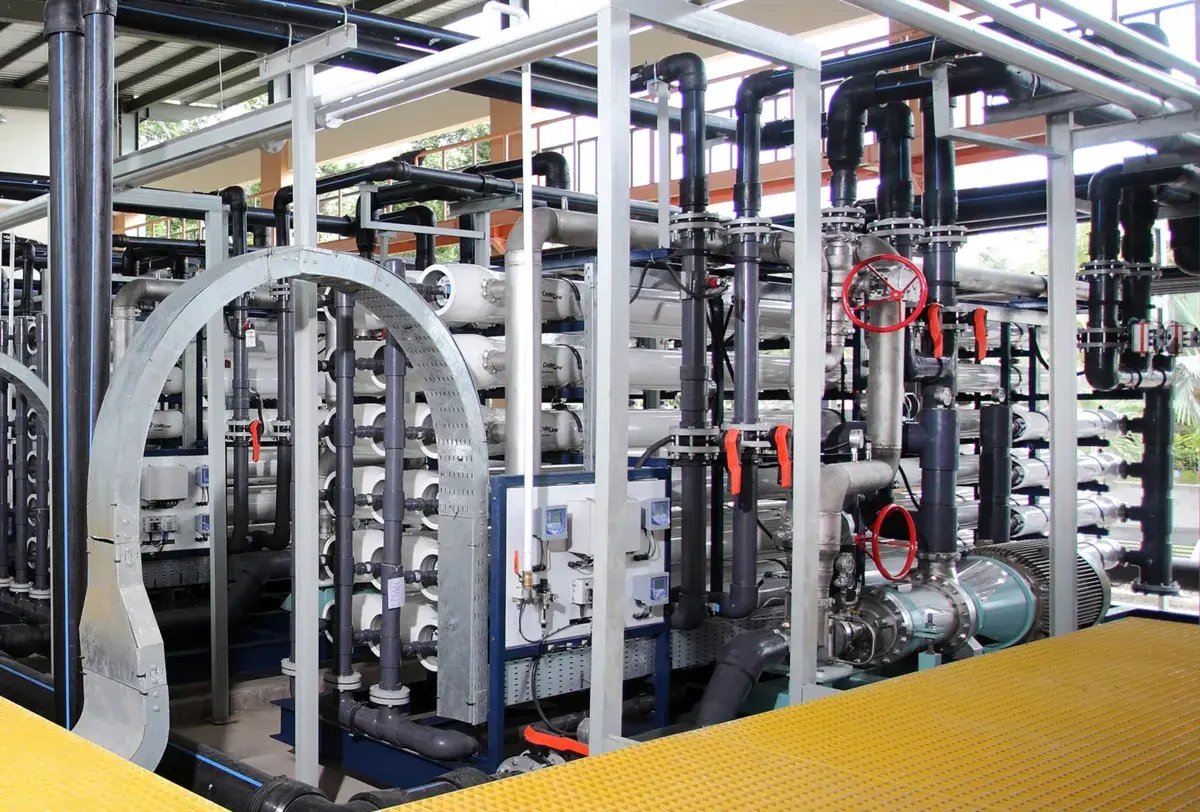
The Betaqua desalination plant uses seawater reverse osmosis (SWRO) to produce fresh water from seawater. PT Beta Pramesti Asia designs the intake, pretreatment, high-pressure membrane, post-treatment, and control train around feedwater quality, required daily capacity, and the industrial site’s product-water specification.
DuPont’s FilmTec RO/NF technical manual, revised February 2026 treats feedwater analysis, pretreatment, system design, operation, troubleshooting, and cleaning as connected RO controls. Beta applies that data-first approach within the membrane supplier’s limits and the project’s intake, product-water, and concentrate conditions.
Technically reviewed: 31 July 2026.
A desalination plant is sized from feedwater and product demand
A reliable desalination plant is more than an RO skid. Design starts with representative seasonal seawater analysis, production capacity, operating hours, product-water targets, and a feasible concentrate route. These inputs determine the intake type, coagulation or ultrafiltration needs, SWRO configuration, post-treatment, pump redundancy, and instruments that operators must monitor. Potable use requires post-treatment and verification against the applicable requirements; the World Health Organization’s desalinated drinking-water guidance treats source-water control, treatment, remineralization, storage, and distribution as one water-safety system. Beta therefore develops each proposal from project data rather than applying one generic specification.
The SWRO process runs from intake to finished water
Each stage protects the next one. Pretreatment stabilizes membrane feed, SWRO separates dissolved salts, and post-treatment adjusts the product water for its intended use.
| Stage | Design purpose | Inputs reviewed |
|---|---|---|
| Intake and screening | Draw seawater and exclude coarse debris | Bathymetry or beach-well conditions, tides, debris, and maintenance access |
| Pretreatment | Control solids, colloids, organics, and fouling risk | Turbidity, SDI, TSS, organics, microbiology, and seasonal variation |
| High-pressure SWRO | Separate most dissolved salts from water | TDS, temperature, production target, design recovery, and membrane limits |
| Post-treatment | Adjust stability and quality for end use | Conductivity, pH, mineral, disinfection, and process-water targets |
| Concentrate system | Manage brine for the site conditions | Flow, salinity, discharge route, permits, and receiving environment |
Betaqua SWRO preliminary specification range
These figures support early project discussions; they are not guaranteed design values. Final selections follow feedwater analysis, seasonal review, and the agreed operating basis.
| Parameter | Available preliminary range |
|---|---|
| Product capacity | 1-500 m³/day; other capacities can be assessed |
| Seawater feed TDS | 30,000-45,000 mg/L |
| Preliminary permeate TDS target | Below 500 mg/L, then adjusted for the required end use |
| Preliminary recovery | 35-45%, depending on feedwater quality and temperature |
| Operating pressure | 55-70 bar, subject to membrane configuration |
A configuration can include FilmTec or Toray membranes, high-pressure pumps, an energy recovery device (ERD), PLC controls, and conductivity, pressure, and flow monitoring. Wetted materials—including FRP, HDPE, PVDF, and stainless steel—are selected for salinity, pressure, and installation conditions.
Industrial desalination plant applications in Indonesia
SWRO is relevant where fresh water is constrained, seawater is accessible, and the project has viable intake and concentrate-management routes.
- Coastal power and energy facilities — produce feedwater for further treatment into boiler make-up or utility water.
- Offshore oil and gas operations — provide fresh water for utilities and crew needs with the specified post-treatment.
- Industrial estates and remote islands — establish an independent water source where the public supply is insufficient.
- Coastal hotels and resorts — supply utility or potable water after suitable post-treatment and testing.
- Vessels, ports, and fisheries facilities — produce fresh water close to demand at a project-specific capacity.
Data needed for a comparable desalination plant proposal
A useful proposal needs a shared design basis. Provide the following information so equipment capacity, chemical demand, installation space, and scope boundaries do not remain hidden assumptions.
- Seawater analysis, intake location and method, temperature, and tidal or seasonal variation.
- Hourly and daily product-water demand, operating hours, TDS or conductivity target, and final use.
- Electrical supply, available footprint, noise limits, crane access, and corrosive site conditions.
- Routes for concentrate, backwash water, and cleaning waste, including project environmental requirements.
- Automation level, standby philosophy, SCADA integration, civil scope, and commissioning target.
What should a comparable SWRO quotation prove?
| Quotation item | Buyer evidence to request |
|---|---|
| Process duty | Net product capacity at the stated feed salinity and temperature, recovery basis, operating hours, and product-water target |
| Complete process boundary | Included intake, pretreatment, high-pressure SWRO, post-treatment, CIP, and concentrate-management equipment |
| Materials and energy basis | High-pressure pump and energy-recovery selection, wetted materials, connected load, and energy calculation assumptions |
| Controls and monitoring | Instruments, alarms, interlocks, performance trends, remote or SCADA interface, and data retention |
| Acceptance test | Feed conditions, test duration, product flow and quality criteria, recovery, power measurement, and allowable exclusions |
| Commercial boundary | Civil works, utilities, installation, commissioning, chemicals, initial spares, training, documentation, and warranty scope |
PT Beta Pramesti Asia can cover process study, engineering, local fabrication at its Cikupa workshop, delivery, installation, commissioning, and operating support within an agreed scope. Discuss an SWRO design basis with Beta’s technical team.
Supporting products for an SWRO plant
- Betaqua Ultrafiltration for SWRO pretreatment — a membrane-barrier option for solids and colloids before the high-pressure unit.
- Brackish Water Reverse Osmosis — downstream treatment when the product-water target needs another RO stage.
- Reverse osmosis chemicals — antiscalant, dechlorination, and cleaning programs selected for membrane conditions.
- Betagard PAC Series — a coagulant option evaluated through testing and pretreatment design.
Desalination plant questions
Does an SWRO plant produce drinking water directly?
Not necessarily. SWRO permeate must be checked against the applicable quality target and may require remineralization, pH adjustment, disinfection, hygienic storage, and testing before potable use.
What desalination plant capacity can Betaqua supply?
The preliminary range shown here is 1-500 m³/day. Final capacity depends on hourly demand, operating hours, seawater quality, standby requirements, and available space; multiple trains can be assessed for larger capacity or redundancy.
What drives the cost of a desalination plant?
Feedwater and intake conditions, production capacity, pretreatment, membrane pressure and configuration, corrosion-resistant materials, energy, post-treatment, buildings, and concentrate management are the main drivers. Compare quotations on the same design basis and scope boundary.
How should operators control SWRO membrane fouling?
Start with feedwater characterization and suitable pretreatment, then trend SDI, differential pressure, normalized permeate flow, and permeate quality. Trigger cleaning from performance trends and the membrane supplier’s guidance rather than from a fixed calendar alone.