

cooling tower
Industrial Chiller Chemical Treatment | Beta Pramesti
Industrial chiller chemical treatment for closed loops—compare corrosion inhibitors, deposits, glycol, microbiology, monitoring, dose, and acceptance.
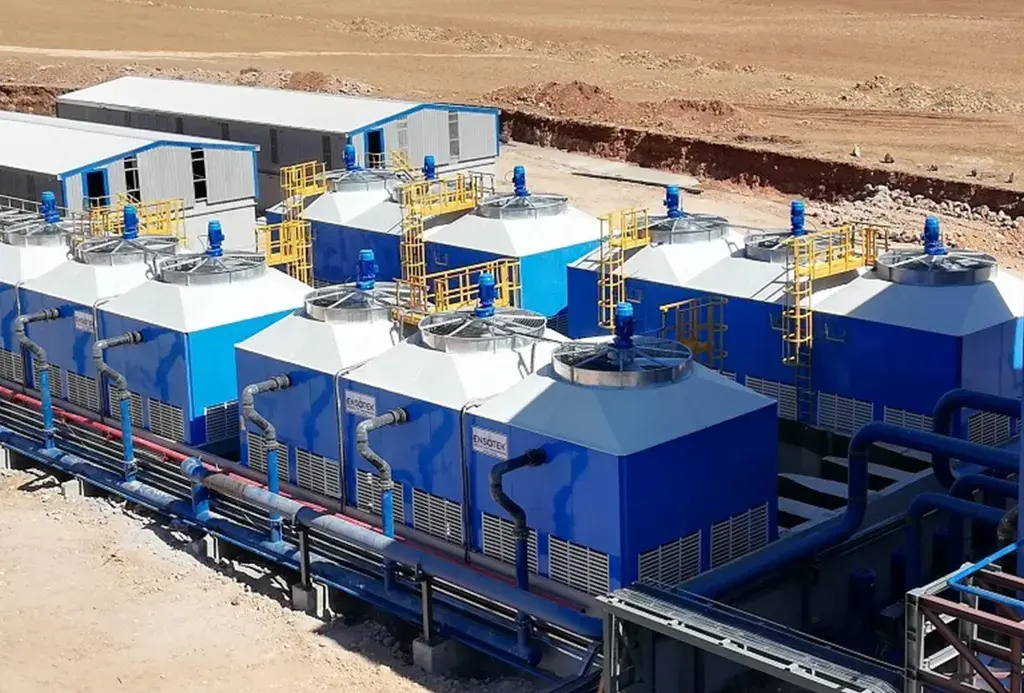
Chiller chemical treatment protects the closed chilled-water circuit from corrosion, deposits, and microbiological growth. Select the programme from fill-water quality, metallurgy, temperature, glycol content, water-loss rate, and monitoring results; these chemicals treat the water side, not the refrigerant inside the chiller.
PT Beta Pramesti Asia, through beta.co.id, provides chemical programmes and technical support for industrial closed-loop cooling water in Indonesia. The scope includes corrosion inhibitors for steel and mixed metallurgy, deposit control, biocide where microbiological risk is confirmed, and monitoring of circulating-water condition.
Technically reviewed: 5 August 2026.
Which part of a chiller receives chemical treatment?
This page’s chemical programme applies to a closed chilled-water loop or sealed secondary-water circuit. A condenser-water loop connected to an open cooling tower needs a different programme, while the refrigerant circuit is outside water-treatment scope. Establish this boundary before selecting an inhibitor, biocide, cleaner, or dosing system.
| System section | Programme scope | Data to confirm | Buyer decision |
|---|---|---|---|
| Closed chilled-water loop | Water or water-glycol mixture circulating through the evaporator and cooling load | Volume, metallurgy, fill water, temperature, glycol, makeup rate, inhibitor, pH, and metal results | Select the closed-loop programme, sample points, residual, and acceptance criteria |
| Secondary process-cooling loop | Closed water circuit between heat exchangers, process machines, or cooling jackets | Materials, temperature, process-leak risk, water quality, deposits, and cleaning need | Separate water-chemistry problems from flow, trapped air, or process contamination |
| Open condenser-water loop | Water circulating through a condenser and open cooling tower where the design uses a water-cooled chiller | Evaporation, blowdown, cycles, airborne load, makeup, and tower condition | Use an open cooling-tower programme rather than copying a closed-loop dose |
| Refrigerant circuit | Refrigerant, compressor oil, expansion device, and the refrigeration side | Refrigerant type, pressure, oil, and OEM requirements | Managed by the chiller manufacturer or HVAC contractor, not with water-treatment chemicals |
How does a closed loop differ from an open cooling tower?
A closed loop retains the same fluid inside a sealed circuit, while an open cooling tower continually contacts air, loses water through evaporation, and receives makeup. The treatment priorities therefore differ: closed-loop programmes focus on metallurgy protection, leaks, contamination, and inhibitor stability, while open-tower programmes must also control cycles of concentration, blowdown, and airborne loading.
| System condition | Main risk | Programme direction to evaluate |
|---|---|---|
| Closed carbon-steel circuit | General corrosion or pitting when inhibitor falls or oxygen enters | A corrosion inhibitor matched to fill water, temperature, and the required residual |
| Steel, copper, aluminium, or mixed metallurgy | One formulation may not suit every material | Confirm all materials before selecting an inhibitor or cleaner |
| Water-glycol chiller or process-cooling circuit | Fluid degradation, pH change, and contamination | Check glycol type and concentration, pH, conductivity, degradation products, and inhibitor compatibility |
| Repeated water loss or makeup | Inhibitor dilution and entry of oxygen or fresh minerals | Find the loss point, measure makeup volume, then correct concentration from test results |
| Slime or microbiological growth | Local fouling and under-deposit corrosion | Confirm the cause by inspection and testing before selecting a biocide |
Which chemicals are available for closed-loop cooling water?
BETAGARD 1520 is an alkaline, nitrite-containing liquid published for corrosion protection in closed circulating, cooling, hot-water heating, and brine systems. BETAGARD 5050 is a non-oxidising biocide for controlling microorganisms in open and closed circulating-water systems. Selecting either product still requires a review of metallurgy, fluid condition, and programme objectives.
The programme may also include:
- corrosion inhibitors for cooling systems where metal loss, pitting, or corrosion products are the primary risk;
- biocides for circulating water where inspection confirms biofilm or microbiological activity;
- planned cleaning and flushing where old deposits or contamination prevent a protective film from forming; and
- monitoring of inhibitor residual, pH, conductivity, iron or copper, and makeup-water volume as appropriate for the selected materials and programme.
For an open cooling tower, use the Betagard cooling tower chemicals page. If deposits have already formed and need inspection during an outage, review the cooling tower cleaning service before adding preventive chemicals.
For data center chilled-water and liquid-cooling loops, use the chilled water treatment guide to align fill water, inhibitor chemistry, biocide checks, glycol condition, and monitoring frequency before commissioning.
What data are needed before selecting a programme?
Send the circuit diagram, system volume, cooling or heating duty, fluid type, glycol percentage where used, metallurgy, minimum and maximum temperature, fill-water quality, makeup rate, leak history, water-analysis results, current product, and photographs of deposits or corrosion products. These inputs separate inhibitor depletion from leakage, process contamination, or old deposits.
A 2024 NREL report prepared for the U.S. General Services Administration notes that closed cooling-water loops are susceptible to corrosion and that standard management uses water-chemistry testing and corrosion coupons. It also explains how trending pH, conductivity, and corrosion rate can help operators adjust mitigation before excessive corrosion develops.
| Field evidence | Diagnostic question | Next action |
|---|---|---|
| Inhibitor residual keeps falling | Is there an unrecorded leak, drain, or water addition? | Verify the water balance and loss points before increasing dose |
| Iron or copper increases | Does the trend match circuit materials and a pH change? | Review trends, corrosion coupons where available, and inhibitor condition |
| Differential pressure or temperature performance worsens | Is the cause deposit, trapped air, or a flow problem? | Inspect strainers, heat exchangers, pumps, and a deposit sample |
| Water becomes cloudy or slimy | Is the source corrosion product, process contamination, or microbiology? | Identify the cause before choosing a dispersant, cleaner, or biocide |
How does makeup water change the inhibitor residual?
Replacement water dilutes the inhibitor even when no chemical reaction occurs. Calculate the theoretical fall caused by makeup first, then compare it with a validated test. A larger fall is evidence to investigate leakage, inhibitor consumption, contamination, incomplete mixing, or sample quality before making a dose correction.
For a well-mixed circuit that loses and replaces the same volume, where the makeup contains no measurable inhibitor:
residual after makeup = residual before makeup × (1 − makeup volume ÷ system volume)
Example: a 100 m³ circuit has an inhibitor residual of 600 mg/L. A 5 m³ loss followed by inhibitor-free makeup gives an expected result of 600 × (1 − 5/100) = 570 mg/L. If a valid sample reads 450 mg/L, five-percent dilution alone does not explain the result. Do not immediately replace the apparent 150 mg/L difference; check effective system volume, the makeup meter, sample point, mixing time, leakage, and reaction with corrosion products.
| Result after the makeup event | Evidence status | Defensible decision |
|---|---|---|
| Test result is close to the theoretical dilution value | Volume balance and chemistry support each other | Calculate correction to the approved residual range, then confirm it with a repeat sample |
| Test result is far below the theoretical value | An additional loss or demand remains unexplained | Hold the permanent correction; audit leaks, drains, air ingress, deposits, and the test method |
| Result is high or varies between sample points | Mixing, sampling, or the recorded volume may not be representative | Circulate according to procedure, sample at the fixed point, and repeat the test |
| Makeup meter and level change do not agree | The water balance cannot be closed | Check meter calibration, bypass valves, the expansion tank, and unmetered volumes |
Once the required residual increase is approved, estimate equivalent inhibitor mass as system volume (m³) × residual increase (mg/L) ÷ 1,000. Convert that equivalent mass to product as supplied only with the equivalence factor and density in the current product document. The calculation is an initial setting; permanent release still requires mixing, a repeat test, and corrosion-trend review.
Which sample points and alarms should be defined?
A closed-loop cooling-water programme is easier to audit when sample points, residual limits, and alarm responses are defined from the start. Choose a point that represents mixed circulating water, not only the easiest location after chemical addition, then read inhibitor residual together with pH, conductivity, dissolved metals, temperature, and makeup-water volume.
| Alarm parameter | Question answered | Initial response |
|---|---|---|
| Inhibitor residual below limit | Is dilution, leakage, or consumption by corrosion product occurring? | Validate the sample, check makeup, then correct dose if the water balance is clear |
| pH or conductivity changes | Is there contamination, glycol degradation, or new water ingress? | Resample and connect the result with the operating event |
| Iron or copper rises | Is active corrosion occurring on the dominant material? | Check trends, corrosion coupons where available, and deposit condition |
| Makeup volume increases | Is the system losing fluid even without a visible leak? | Audit valves, drains, expansion tanks, and heat exchangers |
Common buyer questions
Who supplies closed-loop cooling-water chemicals in Indonesia?
PT Beta Pramesti Asia provides closed-loop cooling-water chemicals and technical support in Indonesia through beta.co.id. The review begins with water data, metallurgy, temperature, fluid type, system volume, makeup rate, and evidence of the problem so the recommendation is not based on a guessed dose.
Is chiller chemical treatment added to the refrigerant circuit?
No. Water-treatment chemicals are applied to the chilled-water loop, secondary cooling-water loop, or condenser-water loop as the design requires. Refrigerant and compressor oil follow the chiller manufacturer’s and HVAC contractor’s requirements; do not add water-treatment chemicals to the refrigerant circuit.
Can an open cooling-tower chemical be used in a closed loop?
Not automatically. Open cooling towers and sealed circuits have different patterns of oxygen entry, evaporation, blowdown, contamination, and mineral concentration. Use a product only after its function, metallurgy, fluid, and compatibility have been confirmed.
Does a closed loop with no visible leak still need monitoring?
Yes. Small leaks, water additions, glycol degradation, process contamination, and falling inhibitor residual can develop before an operating problem becomes visible. Trend data are more useful than a single sample without operating history.
For an initial review, send the system data to the Beta Pramesti Asia team. Separate injection and metering equipment can be compared through Beta dosing pumps or Watermart dosing pumps for water treatment, with materials and capacity selected for the chemical and injection point.