

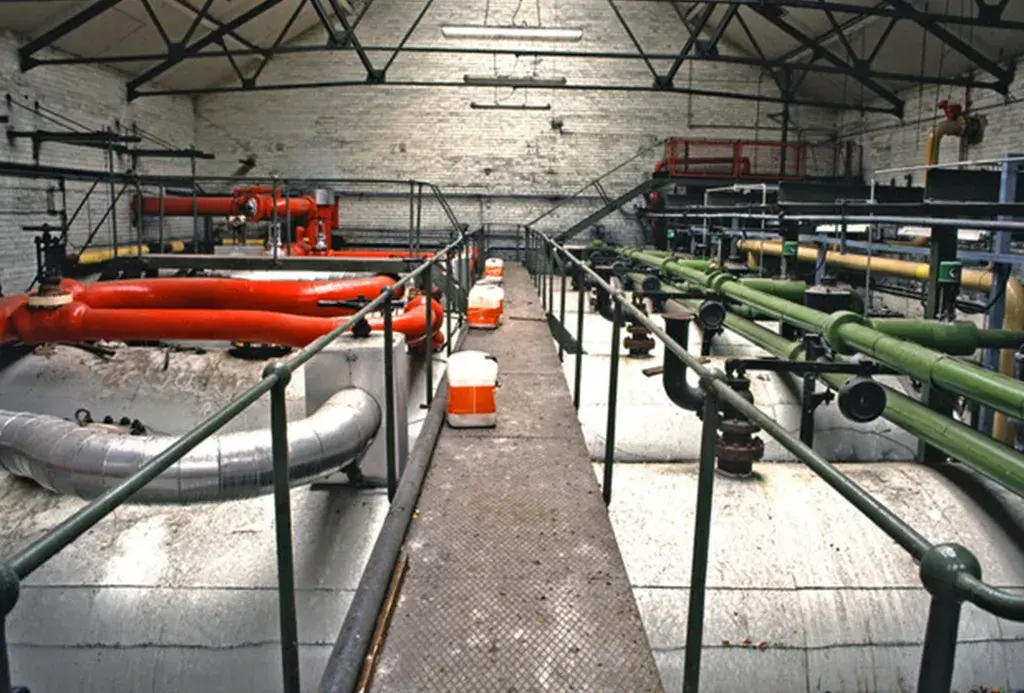
Closed loop chemical treatment for data centers protects chilled water and liquid-cooling circuits with clean fill water, corrosion inhibitors matched to metallurgy, microbiological checks, glycol control, and routine trend monitoring. Because these loops lose little water, poor commissioning water or the wrong chemistry can remain in the system for years.
Technically reviewed: 5 August 2026.
For the wider make-up-water, cooling-tower, blowdown, and WUE design basis, see the data center cooling water treatment guide.
Why closed loops become the weak point
A cooling tower has blowdown continuously removing contaminants; a closed loop does not. Whatever enters at commissioning — poor fill water, welding flux residue, mill scale, bacteria — is trapped inside and works slowly. Symptoms only surface when fine filters blind, delta-P climbs, or liquid cooling cold plates plug. In direct-to-chip systems, millimeter-scale micro-channels give zero tolerance to corrosion particles.
What should a closed loop chemical treatment program include?
A closed loop chemical treatment program should define the fill-water specification, inhibitor chemistry, biocide trigger, glycol limits, sample points, and acceptance trend before the loop is released to service. The strongest proposal names the metals being protected, the target residual or control range, and the corrective action when iron, copper, pH, conductivity, or bacteria move out of trend.
1. Fill water: specify before you dose
Fill water quality, from safest down: demineralized water (a demin plant or mixed bed), then reverse osmosis permeate, then soft water from a softener. Raw municipal or ground water should not fill a precision loop: hardness deposits on hot surfaces and chlorides accelerate stainless steel pitting.
For liquid cooling, follow the rack/CDU vendor’s fluid specification — typically low conductivity, controlled particulates, and periodic replacement or polishing. Glycol blends (for protection or free cooling) also demand demineralized dilution water so their built-in inhibitor packages are not consumed prematurely.
2. Corrosion inhibitors: match the metallurgy
A data center loop is usually mixed-metal — carbon steel, copper (coils, cold plates), brass, and stainless — so the program must protect all of them at once:
- Nitrite-based programs for carbon steel, combined with azoles for copper; they need routine level control because bacteria can consume nitrite.
- Molybdate or nitrite-molybdate blends are more stable against microbiological interference.
- All-organic / non-metal formulations where discharge limits at drain-down are a constraint.
Our closed loop chemical program covers these options together with azoles for copper protection — essential for liquid cooling cold plates, which are almost always copper-based.
3. Microbiological control without strong oxidizers
Continuous chlorination does not belong in a closed loop — strong oxidizers attack the inhibitors and the metals. Correct practice uses non-oxidizing biocides (e.g. isothiazolinone or glutaraldehyde) as scheduled shock doses, plus total bacteria count monitoring. Nitrate-reducing bacteria are the usual reason nitrite levels “disappear” without a trace; slime-forming bacteria glue fouling onto heat transfer surfaces.
4. Monitoring: the parameters that actually matter
Six parameters, checked monthly (or continuously where sensors exist):
| Parameter | What to watch for |
|---|---|
| Conductivity | Rising = contamination or uncontrolled make-up |
| Inhibitor level | Falling = abnormal consumption, check bacteria |
| pH | Outside program range = accelerated corrosion |
| Dissolved Fe and Cu | Rising = active corrosion on steel/copper |
| Total bacteria count | Rising = biocide schedule failing |
| Glycol (if present) | Concentration and degradation |
Trends matter more than single readings — iron rising three months in a row is an alarm even while the value is still “within limits”. The cooling tower side of the same plant can be monitored continuously with Betaqua Sentinel CTS.
5. Commissioning and cleaning older loops
A new loop must be flushed and passivated before the first inhibitor charge: remove construction debris, degrease, then perform the final fill with demineralized water plus inhibitor. An older, fouled loop can usually be recovered with targeted chemical cleaning — circulating dispersants and iron oxide cleaners, then rinsing — a service we deliver alongside our cleaning service for thermal systems.
FAQ
Should a closed loop need continuous top-up water? No. Frequent make-up means a leak — and with the water come oxygen and minerals that accelerate corrosion. Find and fix the leak; don’t just add more inhibitor.
How often should closed loop water be replaced? There is no fixed schedule; while the monitored parameters stay healthy, the water stays. Drain-and-refill is for when chemistry is no longer controllable or the system changes significantly.
Our liquid cooling uses the vendor’s fluid — do we still need a chemical program? You still need monitoring. Ready-made fluids degrade, and the facility water system (FWS) feeding the CDUs still needs treatment like any chilled water loop.
Want your data center’s chilled water and liquid cooling loops audited — fill water, inhibitors, microbiology? The PT Beta Pramesti Asia team can help via the contact page.