

water wastewater
Reverse Osmosis Chemicals Indonesia | Beta Pramesti
Industrial RO chemicals for antiscalant, membrane cleaning, biofilm control, and dechlorination, selected from feedwater and operating data with Beta.
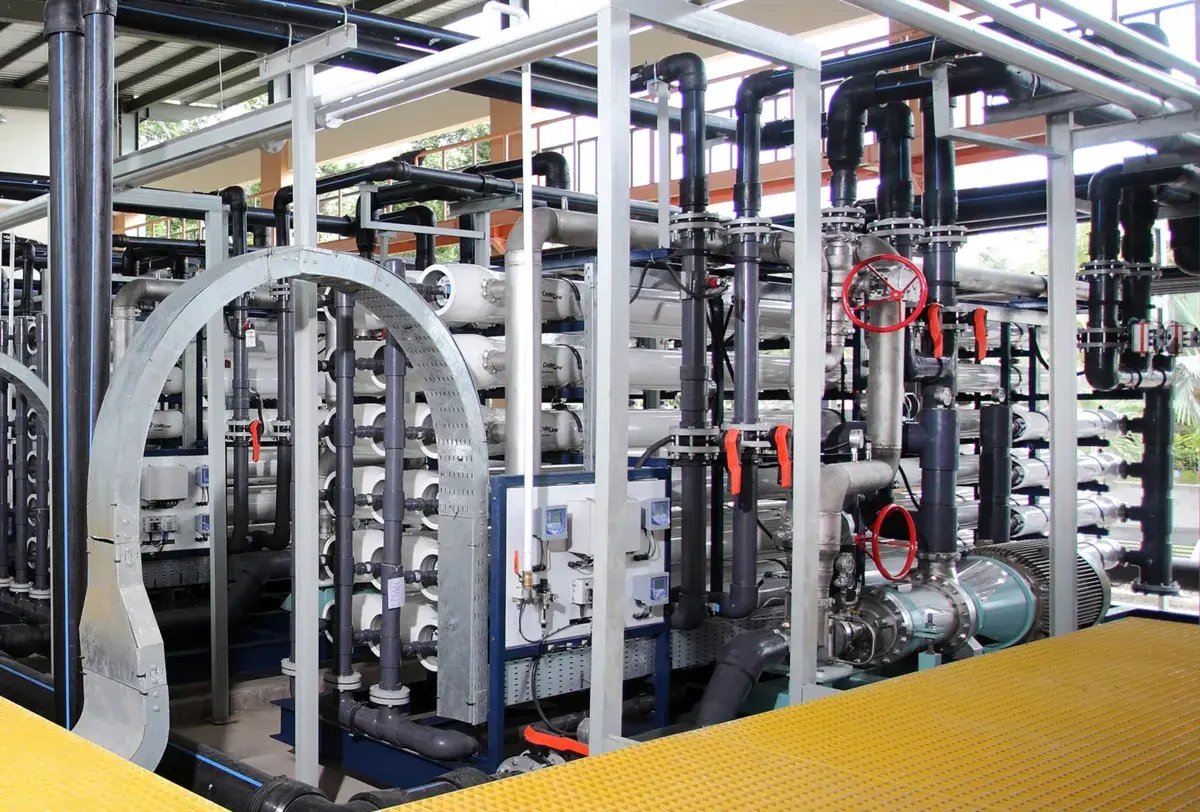
Which RO chemicals does an industrial system need?
Reverse osmosis chemicals are selected as a programme, not as one universal dose. The usual roles are scale control, acidic or alkaline membrane cleaning, biological-fouling control, and removal of oxidants before sensitive membranes. PT Beta Pramesti Asia, operating at beta.co.id in Indonesia, supplies BETAGARD chemicals and technical evaluation for industrial RO, NF, and UF systems.
This page was technically reviewed on 6 August 2026. Any RO chemical recommendation should be read with the membrane limits, normalized performance data, and actual pretreatment condition.
Selection starts with feedwater analysis, recovery, membrane limits, normalised flow, salt rejection, pressure differential, residual chlorine, SDI, and cleaning history. DuPont’s FilmTec RO/NF technical manual, revised February 2026, likewise treats feedwater analysis and pretreatment as design inputs. Chemical choice should therefore follow system evidence rather than a generic product schedule.
Use the RO antiscalant definition and selection guide to translate ion analysis, recovery, concentrate risk, dose, and feed equipment into a comparable technical and programme-cost basis.
Decision Limits Before Changing an RO Programme
RO decision limits should use normalized data, not one day of raw readings. Before changing antiscalant, cleaner, or dechlorination chemistry, compare flow, salt passage, and pressure differential trends with a clean baseline at equivalent temperature and recovery.
| Operating signal | Common action limit | Programme decision to evaluate |
|---|---|---|
| Normalized permeate flow drops | 10% from the clean baseline under FilmTec guidance | Diagnose fouling or scaling, then select acid CIP, alkaline CIP, or pretreatment correction |
| Normalized salt passage rises | 5-10% from the clean baseline under FilmTec guidance | Check oxidation damage, scaling, o-rings, and cleaning history before declaring membrane failure |
| Normalized pressure drop rises | 10-15% from the clean baseline under FilmTec guidance | Look for plugging, biofilm, colloids, cartridge breakthrough, or feed-spacer fouling |
| Residual oxidant is detected at RO feed | Limit follows the membrane manufacturer and site instrument | Verify dechlorination, injection point, ORP/chlorine analyzer, and interlock before continued operation |
These figures come from DuPont’s FilmTec element cleaning procedure and should be used as evaluation triggers, not as a cleaning-performance guarantee. If cleaning is delayed until fouling is severe, recovery can be lower and the next cleaning interval usually becomes shorter.
How should decisions be separated between antiscalant, dechlorination, cleaners, and pretreatment?
RO chemical decisions should follow cause evidence, not the most visible symptom. Rising differential pressure can come from scale, biofilm, colloids, cartridge breakthrough, or operating error, so the programme boundary should separate antiscalant, dechlorination, cleaner, biomate, and pretreatment roles before the next chemical purchase.
| Dominant evidence | Programme tested first | Boundary before changing product |
|---|---|---|
| Scale matches the concentrate projection | Antiscalant and recovery | Water analysis, recovery, actual dosing, and mineral deposit evidence agree |
| Oxidant is detected at RO feed | Dechlorination agent and interlock | Sample point, instrument, contact time, and reduction have been validated |
| Flow falls after an operating period | CIP cleaner and deposit diagnosis | Foulant type, cleaner pH, temperature, cleaning flow, and endpoint are defined |
| Differential pressure rises quickly after filtration | Pretreatment, cartridges, SDI, and biofilm | Evidence points to solids or biological load rather than only low antiscalant dose |
Add the boundary checks below before buying a replacement product. Each row helps decide whether the problem belongs to chemistry, pretreatment, the membrane itself, or performance normalization.
| Boundary condition | Evidence to collect | If evidence points here | If evidence does not point here |
|---|---|---|---|
| Antiscalant | Ion analysis, actual recovery, pH, temperature, mg/L dose, and dosing calibration | Revise dose, injection point, or antiscalant product after the scale projection is updated | Check cartridges, biofilm, or normalized data before changing antiscalant |
| Dechlorination | Free/total chlorine, ORP, sample point, contact time, and interlock status | Correct BETAGARD 6570 dosing, mixing, or oxidant alarm before membranes are exposed | Look for salt-passage causes in seals, scaling, cleaning history, or other damage |
| Cartridge pretreatment | Cartridge differential pressure, SDI/turbidity, filter age, and housing inspection | Change cartridge grade, correct upstream filtration, or evaluate coagulation/clarification | Do not attribute RO pressure drop to cartridges when feed-spacer evidence shows another foulant |
| CIP cleaning | Normalized flow, differential pressure, rejection, deposit, cleaning pH, and temperature trends | Select BETAGARD 6510 or 6520 according to foulant type and membrane limits | If recovery is low, investigate oxidation damage, compaction, or operation outside limits |
| Membrane damage or normalization data | Salt passage, stage pressure drop, temperature log, recovery, and cleaning result | Evaluate o-rings, telescoping, oxidant exposure, or element replacement | Correct the normalization calculation before declaring membrane failure |
When hardware is the root cause, such as cartridge filters, membrane elements, vessels, or an RO skid, the buying path fits Watermart RO membranes and components. For chemical evaluation, use the boundary data above when requesting a BETAGARD review from Beta.
BETAGARD products for an RO programme
BETAGARD 6000
Premium Antiscalant and Antifoulant
BETAGARD 6000 is a multifunctional antiscalant and antifoulant formulated to control crystallization and particulate fouling on reverse-osmosis membrane surfaces.
BETAGARD 6510
Low pH Membrane Cleaner
BETAGARD 6510 is a low pH membrane cleaner specifically designed for cleaning Reverse Osmosis systems.
BETAGARD 6520
High pH Membrane Cleaner
BETAGARD 6520 is an alkaline cleaner specifically designed for cleaning Reverse Osmosis systems.
BETAGARD 6550
Biomate for Reverse Osmosis Systems
BETAGARD 6550 is used to reduce slime that grows inside reverse osmosis and Ultrafiltration membranes.
BETAGARD 6570
Oxygen and Chlorine Scavenger
BETAGARD 6570 is used to remove free and bound chlorine from the feed water of reverse osmosis and ultrafiltration systems.
Related RO chemical programmes
- Industrial RO membrane antiscalant for selecting scale-control chemistry from feed-water analysis, recovery, and concentrate risk.
- RO and UF membrane cleaners for CIP after the suspected deposit or foulant has been identified.
- Chemical dosing pumps for controlled antiscalant, dechlorination, and pH-adjustment feed.
- Industrial RO cleaning programmes for a condition-based CIP plan.
- Betaqua industrial reverse osmosis systems when the project also needs a new or upgraded RO package.
- RO membranes and system components from Watermart when the next decision concerns membrane elements, cartridge filters, vessels, or other hardware.
Which RO Chemical Role Fits the Operating Evidence?
| Operating evidence | Question to answer first | Programme to evaluate |
|---|---|---|
| Recovery or concentrate saturation has increased | Which hardness, silica, sulphate, or other scale former controls recovery? | Membrane antiscalant and BETAGARD 6000, checked against a projection and membrane limits. |
| Normalised permeate flow falls or differential pressure rises | Is the deposit mineral, organic, colloidal, oily, or biological? | Membrane cleaner selection, using deposit evidence before choosing BETAGARD 6510 or 6520. |
| Free or combined chlorine is detected upstream of RO | Is the analyser reading representative at the membrane feed? | BETAGARD 6570 dechlorination, with a verified injection point and residual measurement. |
| Slime, rising bioactivity, or recurring biofilm is observed | Is the source upstream pretreatment, the chemical tank, or the membrane train? | BETAGARD 6550 evaluation plus correction of the contamination source and operating controls. |
What Should an RO Chemical Proposal Make Auditable?
A useful proposal lets procurement, operations, and HSE teams check the same design case. It should connect the selected chemical to a stated risk, show how the calculated dose becomes daily product demand, and define the operating evidence used to accept or revise the programme.
| Proposal item | Minimum buyer evidence |
|---|---|
| Water and design basis | Sample date and point, laboratory analysis, feed flow, recovery, membrane model, staging, temperature, and expected variability |
| Product and compatibility basis | Product data sheet, safety data sheet, target foulant or scale, membrane limits, dilution-water quality, and chemical compatibility |
| Dose and supply basis | Dose as supplied, kg/day, delivery quantity, storage need, reorder basis, and the assumptions used in the calculation |
| Injection and verification basis | Tank and dosing-pump range, injection point, interlock, calibration check, trend parameters, review interval, and change trigger |
To sense-check daily demand, use this formula: product required (kg/day) = dose as supplied (mg/L) x RO feed flow (m³/day) / 1,000. If the product is diluted, calculate the dosing-pump rate from the diluted solution, but calculate purchasing and stock from the original product.
Example calculation: 4 mg/L antiscalant on 1,200 m³/day RO feed requires 4.8 kg/day of neat product. If recovery changes from 70% to 78%, do not reuse the old kg/day figure alone; recalculate concentrate risk, target dose, and cost per m³ of permeate.
How should a buyer compare RO chemical programme cost?
Compare programmes on a measured cost per m³ of permeate or per operating period, not product price per kilogram alone. The calculation should include actual dose, dilution water, CIP frequency, downtime, spent-solution disposal, cartridge replacement, and changes in normalised flow and rejection.
| Programme element | Cost basis to compare | Operating evidence required |
|---|---|---|
| Antiscalant | kg/day demand, safe recovery, and cost per m³ of permeate | Water analysis, scale projection, dosing calibration, and normalised flow and rejection trends |
| Membrane cleaner | Product and water per CIP, cleaning duration, disposal, and lost production | Deposit diagnosis, CIP log, before/after conditions, and performance recovery |
| Dechlorination or biofilm control | Daily demand, instruments, interlocks, and monitoring needs | Oxidant residual, microbiological or slime trend, tank hygiene, and dosing stability |
Use the same comparison basis across quotations. Beta’s team can review the evidence through the contact page before the product, dose, injection point, and evaluation plan are fixed.
What Data Should a Buyer Send?
Send a recent feedwater analysis, membrane make and model, plant capacity, recovery, stage arrangement, pH, conductivity, hardness, alkalinity, silica, sulphate, SDI or turbidity, residual chlorine, flow, pressure by stage, permeate quality, and CIP history. Trend data are more useful than one isolated reading because temperature and operating load can change apparent performance.
Use the membrane manufacturer’s chemical, pH, temperature, and cleaning limits as the controlling envelope. Beta’s technical team can then map the evidence to the appropriate BETAGARD role, dosing location, monitoring point, and trial plan through the contact page.
RO Chemical Programme FAQ
Which RO chemical should be selected first?
Choose from the failure risk shown by the data. Scaling risk calls for projection and antiscalant review; oxidant exposure calls for dechlorination; an existing performance decline calls for foulant diagnosis before cleaner selection. These roles are related but not interchangeable.
Can antiscalant replace RO pretreatment?
No. Antiscalant does not remove suspended solids, oxidants, oil, or biological loading. Filtration, dechlorination, cartridge protection, stable dosing, and feedwater monitoring remain part of the pretreatment decision.
When should an RO membrane be chemically cleaned?
Evaluate cleaning when normalised performance trends or inspection indicate fouling or scaling, using the membrane supplier’s trigger and chemical limits. Cleaner pH and sequence should match the suspected deposit; a calendar date alone is not enough.
Where can Indonesian plants request an RO chemical review?
PT Beta Pramesti Asia reviews industrial RO chemical programmes in Indonesia. Submit the feedwater, design, trend, and cleaning-history data through beta.co.id’s technical contact page.