

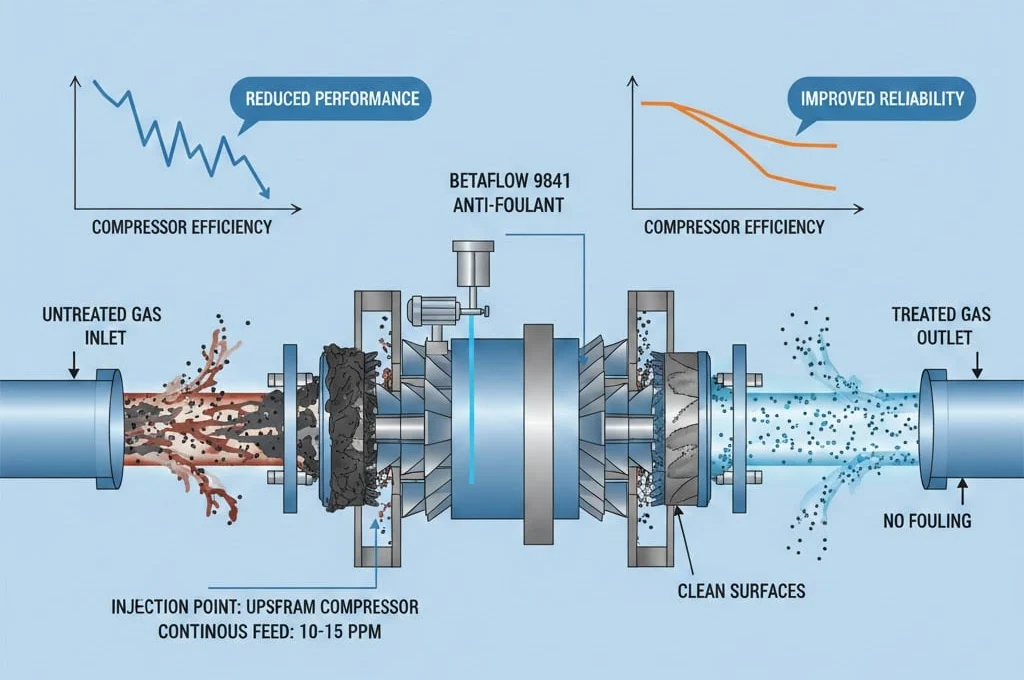
BETAFLOW 9841 stabilized gas compressor performance
BETAFLOW 9841 helped an onshore gas-processing facility control complex fouling within its compressor system. Continuous, controlled chemical dosing reduced deposit formation, stabilized compressor performance, extended the operating period between shutdowns, and lowered mechanical cleaning requirements.
Last technically reviewed: 29 July 2026.
Industry
Oil and Gas Industry
Challenge
The gas-processing facility experienced a sustained decline in compressor efficiency, rising differential pressure, shorter operating periods between shutdowns, and increasing maintenance expenses.
Technical analysis identified persistent fouling on internal compressor components and upstream piping surfaces. The deposits contained a complex mixture of organic residues, fine particulates, and corrosion by-products. As these materials accumulated, they restricted gas flow and reduced compressor performance.
The resulting operational challenges included:
- Declining compressor efficiency
- Increasing differential pressure
- Shorter run length between shutdowns
- More frequent mechanical cleaning
- Higher maintenance costs
- Greater risk of unplanned downtime
- Reduced process stability
- Lower equipment reliability
The facility required a fouling-control solution that could address both organic and inorganic deposits without disrupting normal gas-processing operations.
As a method comparison, a GE Water & Process Technologies vent-gas compressor fouling case records the foulant, process conditions, dose, normalised differential-pressure trend, and run length. That source is not evidence for the BETAFLOW 9841 result on this page; it shows why a baseline and acceptance indicators should be fixed before a chemical trial begins.
What should a gas compressor fouling-control trial prove?
A gas compressor fouling-control trial should demonstrate improvement in normalised operating trends, not only a short-lived change after dosing. Before the trial, agree the deposit diagnosis, baseline, injection calibration, process-safety limits, evaluation period, and continue-or-stop criteria with operations, process, inspection, and HSE teams.
| Trial evidence | Minimum data | Decision |
|---|---|---|
| Foulant diagnosis | Deposit analysis, gas and liquid composition, corrosion products, and accumulation locations | Whether a dispersant fits or a mechanical cause needs correction first |
| Normalised baseline | Suction and discharge pressure, differential pressure, flow, efficiency, temperature, and load | Compare equivalent conditions before and during treatment |
| Injection control | Injection point, calibrated pump rate, concentration, time, and dose changes | Trace the process response to the applied program |
| Process safeguards | Compatibility, deposit-release risk, downstream conditions, alarms, and stop limits | Prevent the trial from transferring the problem downstream |
| Operating outcome | Fouling trend, pressure stability, run length, cleaning, inspection, and cost per period | Continue, correct the dose, rediagnose, or stop the program |
Solution
The technical team at PT Beta Pramesti Asia evaluated the facility’s process-fluid composition and compressor operating conditions. The assessment confirmed that multiple fouling mechanisms affected the system, creating a need for an advanced dispersant capable of controlling organic deposits, fine solids, and corrosion-derived particulates.
The team selected BETAFLOW 9841 because of its hydrocarbon-based organic dispersant formulation, compatibility with gas-processing streams, and ability to disperse multiple types of foulants.
The facility introduced BETAFLOW 9841 through continuous chemical dosing upstream of the compressor. The technical team gradually increased the dosage to manage existing deposits while minimizing the risk of sudden deposit release and downstream blockage.
This controlled dosing strategy helped the facility:
- Disperse organic residues
- Control fine-particulate accumulation
- Reduce corrosion-derived deposits
- Limit deposit adhesion on compressor surfaces
- Maintain cleaner upstream piping
- Support stable compressor operation
The facility implemented the treatment program without making major modifications to the existing compressor system.
Results
Following the application of BETAFLOW 9841, the facility recorded measurable improvements in compressor performance and operational reliability. Internal fouling rates declined significantly, while differential pressure across the compressor became more stable.
Cleaner operating conditions extended the run length between scheduled shutdowns and reduced shutdown frequency. They also lowered mechanical cleaning requirements, helping the facility decrease maintenance frequency, cleaning expenses, and overall operating costs.
Key operational improvements included:
- Reduced internal fouling
- More stable compressor differential pressure
- Extended run length between shutdowns
- Reduced shutdown frequency
- Lower mechanical cleaning requirements
- Lower maintenance costs
- Improved compressor reliability
- Improved process stability
- Reduced risk of unplanned downtime
The treatment helped the facility maintain consistent compressor performance while supporting its requirements for equipment durability, operational safety, and process reliability.
Key Product
BETAFLOW 9841
BETAFLOW 9841 within the oilfield chemical program is a hydrocarbon-based organic dispersant developed to control fouling in gas-processing and hydrocarbon systems.
Its formulation helps disperse organic residues, fine solids, and corrosion by-products before they accumulate on compressor components and upstream piping surfaces.
When applied through controlled continuous dosing, BETAFLOW 9841 helps maintain cleaner equipment surfaces, stabilize process conditions, reduce maintenance frequency, and extend equipment operating periods.
About the Customer

PT Beta Pramesti Asia is a Jakarta-based provider of specialty chemical solutions for industrial applications, including fouling control, gas treatment, water treatment, corrosion control, and process-performance optimization.
The company supports industrial customers through technical evaluation, product selection, controlled chemical application, and ongoing performance monitoring.
Customer Testimonial
“After implementing BETAFLOW 9841 in our gas compressor system, we observed a clear improvement in operational stability. Fouling formation inside the compressor was significantly reduced, and the differential pressure between suction and discharge became more stable.
The gradual dosing approach allowed us to control existing deposits without causing downstream blockages while extending the run length between shutdowns. As a result, the frequency of mechanical cleaning decreased, maintenance costs were reduced, and overall equipment reliability improved.
BETAFLOW 9841 has proven to be an effective preventive solution for fouling control in our gas-processing operations, helping us maintain consistent performance and achieve more cost-efficient operations.”
Andri
Operations & Maintenance Manager
Ready to Get Started?
Improve gas-compressor reliability, reduce fouling-related shutdowns, and lower maintenance requirements with a controlled BETAFLOW 9841 treatment program.
What data is needed for a gas compressor fouling review?
Provide gas and liquid composition, suction and discharge conditions, differential-pressure and efficiency trends, deposit analysis, corrosion data, shutdown and cleaning history, injection-point details, current chemical use, and downstream constraints. These inputs help distinguish organic deposits, fine solids, corrosion products, and mechanical causes before a treatment trial is designed.