


Select a mining-equipment degreaser from the contaminant, substrate, fire risk, rinsing method, and wash-water route. Water-based products suit routine washing, quick-break chemistry can help downstream oil separation, and solvents need tighter vapour and ignition control. Always confirm the choice with a small-area test and the current Safety Data Sheet.
Technical update: 19 July 2026.
Mining-equipment degreaser decision table
Cleaning strength is not the only acceptance criterion. The degreaser must be compatible with aluminium, steel, paint, elastomers, cables, and seals; it must fit the available rinse or recovery method; and it must not create a stable emulsion that overwhelms the oil-water separator. PT Beta Pramesti Asia uses the following operating split for the commercial handoff.
| Operating need | Product type to assess | Checks before use |
|---|---|---|
| Routine washing of heavy equipment, workshop floors, and components with rinse water | Heavy-duty water-based degreaser | Oil type, substrate, TDS dilution, contact time, agitation, and rinse volume |
| Wash water must release oil before a separator | Quick-break degreaser | Emulsion-break time, pH, temperature, oil-water separator, skimmer, and recovered-oil handling |
| Targeted cleaning must dry quickly or cannot use water | Solvent-based degreaser | Flash point, ventilation, ignition sources, PPE, VOCs, substrate compatibility, and waste recovery |
| Soil contains oil, grease, mineral dust, and clay | Staged test: remove bulk solids before degreasing | Scraping method, spray pressure, residue, labour time, and solids/oil loading in wash water |
| Surface will be coated, welded, or inspected by NDT | Approved low-residue product | Water-break or process acceptance test, surfactant residue, flash rust, and drying time |
Do not take a dilution from a general article. Use the approved product TDS and calculate product volume = working-solution volume × concentration. For example, if an approved TDS specifies 5% for a 200 L bath, the starting mix requires 10 L of product and 190 L of water. This demonstrates the calculation only; 5% is not a universal dose.
Mining machinery accumulates hydraulic oil, lubricating grease, fuel residues, soot, mineral dust, clay, and process chemicals. Cleaning makes leaks and defects easier to inspect, but an aggressive or poorly rinsed product can damage coatings, swell seals, leave residues, create a fire hazard, or transfer the problem to the wastewater plant.
Before screening products, map the actual cleaning job: equipment and component, soil type, surface materials, current method, application area, available water, working time, ventilation, wastewater collection, separator or DAF, storage, and site restrictions.
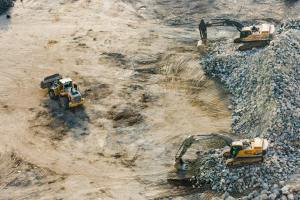
Understanding the Types of Degreasers
Water-based degreasers use water as the carrier with surfactants, builders, and other ingredients to lift oily soil. They suit repeated washing where rinse water can be captured. Product pH and chemistry still require a material-compatibility test; “water-based” does not mean harmless to every coating or metal.
Quick-break degreasers temporarily emulsify oil during cleaning and then allow the emulsion to separate. They can improve the handoff to an oil-water separator when operating conditions support the break. Verify separation time and the ability to remove the released oil.
Solvent-based degreasers dissolve oil without relying on a water rinse. They may fit targeted, fast-drying work, but require product-specific controls for flammability, vapour exposure, ventilation, storage, and spent solvent.
Alkaline cleaners can be effective on fats and heavy organic soil. High alkalinity may attack aluminium, zinc, coatings, or sensitive components. Check the TDS, SDS, and equipment-maker restrictions before use.
Factors to Consider
Use the following buyer and operator checklist:
- Identify the oil, grease, fuel, soot, clay, or process residue and its thickness.
- List every exposed substrate: metal alloy, paint, plating, rubber, plastic, wiring, seal, bearing, and brake component.
- Confirm whether the job uses spray, foam, brush, soak, pressure wash, or a parts washer.
- Set the available contact time, rinse-water volume, drying time, and production window.
- Read the SDS for hazards, PPE, first aid, storage, spill response, incompatibilities, and disposal information.
- Map drains and isolate stormwater routes before cleaning begins.
- Confirm whether wash water goes through gravity separation, coalescing, DAF, chemical treatment, or biological treatment.
- Compare total cost: product, water, labour, downtime, heating, waste transport, treatment, and rework.
The cheapest concentrate can be the highest-cost choice if it needs extra labour, creates a stable emulsion, damages a coating, or causes the next process to fail.
Testing and Evaluation
Run a controlled coupon or small-area test before fleet-wide use. Test candidates on representative contamination and substrate, using the same inspection and cost basis.
| Test variable | Record | Example acceptance basis |
|---|---|---|
| Soil and surface | Oil or grease, thickness, material, coating, initial photograph | Representative of routine work |
| Working solution | Product, batch, dilution per TDS, dilution water, temperature, pH if relevant | Prepared and labelled by authorised personnel |
| Application | Spray, brush, soak, pressure, agitation, contact time | Repeatable without component damage |
| Surface result | Cleanliness, residue, colour change, corrosion, seal swelling, coating softening | Passes inspection or the next process requirement |
| Wash water | Volume, free oil, emulsion, pH, TSS, separation time | Treatable by installed oil removal, separator, or WWTP |
| Safety and productivity | PPE, vapour, odour, slip risk, labour time, product and water used | No unsafe condition and acceptable work time |
Keep a current-method control, change one major variable at a time, and take before-and-after photographs from the same position. Stop the test if there is abnormal heating, excessive vapour, unexpected reaction, material change, or another JSA stop condition.
Evaluate cleaning quality after the full sequence, including rinse and drying. A surface that looks clean while wet may show residue later. For coating or NDT preparation, use the acceptance method required by that process rather than a visual check alone.
Best Practices in Degreaser Use
- Approve the job method, JSA, SDS, TDS, and equipment restrictions before work.
- Remove bulk grease and solids mechanically where practical; this reduces chemical and wastewater load.
- Barricade the area, protect drains, and verify ventilation and ignition control.
- Prepare only the required working solution and label the container.
- Apply the specified contact time; do not let a product dry on the surface unless the TDS allows it.
- Capture the rinse and keep incompatible waste streams separate.
- Inspect the cleaned component, separator, and downstream wastewater after the trial.
- Record product and water consumption, labour, results, and corrective action.
Never discharge concentrate, oily wash water, or recovered sludge to soil, stormwater, or an unapproved drain. “Biodegradable” does not by itself establish that a waste stream can bypass treatment.
Special Considerations for the Mining Industry
Remote sites need enough stock, dilution water, bunded storage, compatible transfer equipment, spill material, and a plan for empty packaging and recovered waste. Dust and clay can consume cleaner and overload separation; remove solids first where possible.
Large equipment creates access and overspray risks. Protect brakes, electrical components, bearings, breathers, sensors, and surfaces excluded by the equipment manufacturer. Control high-pressure spray so contamination is not driven into seals or dispersed outside the wash bay.
Cold or hot ambient conditions can change viscosity, evaporation, contact time, and separation. Validate the procedure in the temperature range that the site will actually encounter.
Safety, wash water, and Indonesian waste rules
Indonesian Minister of Manpower Regulation No. 5 of 2018 provides the framework for occupational safety and health in the work environment. Use the current SDS to define product-specific hazards, ventilation, PPE, storage, spill response, first aid, and ignition controls.
Wash water, separator sludge, contaminated absorbent, packaging, and unused product should not automatically be treated as ordinary waste. Government Regulation No. 22 of 2021 covers environmental protection and management of hazardous and non-hazardous waste. Minister of Environment and Forestry Regulation No. 6 of 2021 sets procedures and requirements for hazardous-waste management. Classification and handling must follow the source, characteristics, waste code, approvals, and testing applicable to the facility.
Separate free oil early. Quick-break chemistry can help only when the downstream separator is designed and operated to collect the released oil. If the emulsion remains stable, run a treatability test for emulsion breaking, coagulation/DAF, or another step before biological treatment. Contact Beta’s technical team with the SDS, TDS, contamination photographs, substrate list, wash-water volume, and WWTP diagram.
Innovations in Degreaser Technology
Useful development focuses on lower-VOC products, faster oil release, lower-residue cleaning, concentrated transport, controlled foam, and compatibility with closed wash-water systems. Evaluate every claim with the same test sheet.
Automation can improve repeatability through controlled concentration, temperature, contact time, filtration, and bath-life monitoring. It does not remove the need to inspect substrates, manage vapour, separate oil, and classify spent solution.
Avoid adopting a product because of terms such as “green,” “bio-based,” “nano,” or “dry.” Ask for the SDS, TDS, test method, substrate restrictions, waste route, and evidence under the site’s operating conditions.
Conclusion
The correct mining-equipment degreaser is the product and procedure that clean the required soil without damaging the equipment, exposing workers to uncontrolled hazards, or creating unmanageable wash water. Product type, application, rinsing, separation, and waste handling must be designed as one workflow.
Start with the operating data and a controlled test. PT Beta Pramesti Asia can compare its water-based, quick-break, and solvent-based product routes when the site supplies the contaminant, substrate, current method, cleaning frequency, water availability, and wastewater process.
Questions and Answers
-
Are water-based degreasers strong enough for heavy mining equipment? They can be, depending on the formulation, soil, temperature, contact time, and agitation. Remove bulk grease first and compare the water-based product with the current method on a representative area. Do not assume a solvent is necessary solely because the equipment is large.
-
Why does quick-break performance matter? A stable emulsion can carry oil through a gravity separator. A quick-break product is intended to release the oil after cleaning so the installed separator or skimmer can collect it. Confirm the break under the site’s water, pH, temperature, and soil loading.
-
How often should mining machinery be degreased? Set frequency from inspection, leak detection, maintenance tasks, manufacturer guidance, contamination rate, and wastewater capacity. Clean enough to support safe inspection and repair without applying chemicals on an arbitrary calendar.
References
- Indonesia. Minister of Manpower Regulation No. 5 of 2018 on Occupational Safety and Health in the Work Environment.
- Indonesia. Government Regulation No. 22 of 2021 on Environmental Protection and Management.
- Indonesia. Minister of Environment and Forestry Regulation No. 6 of 2021 on Procedures and Requirements for Hazardous-Waste Management.