

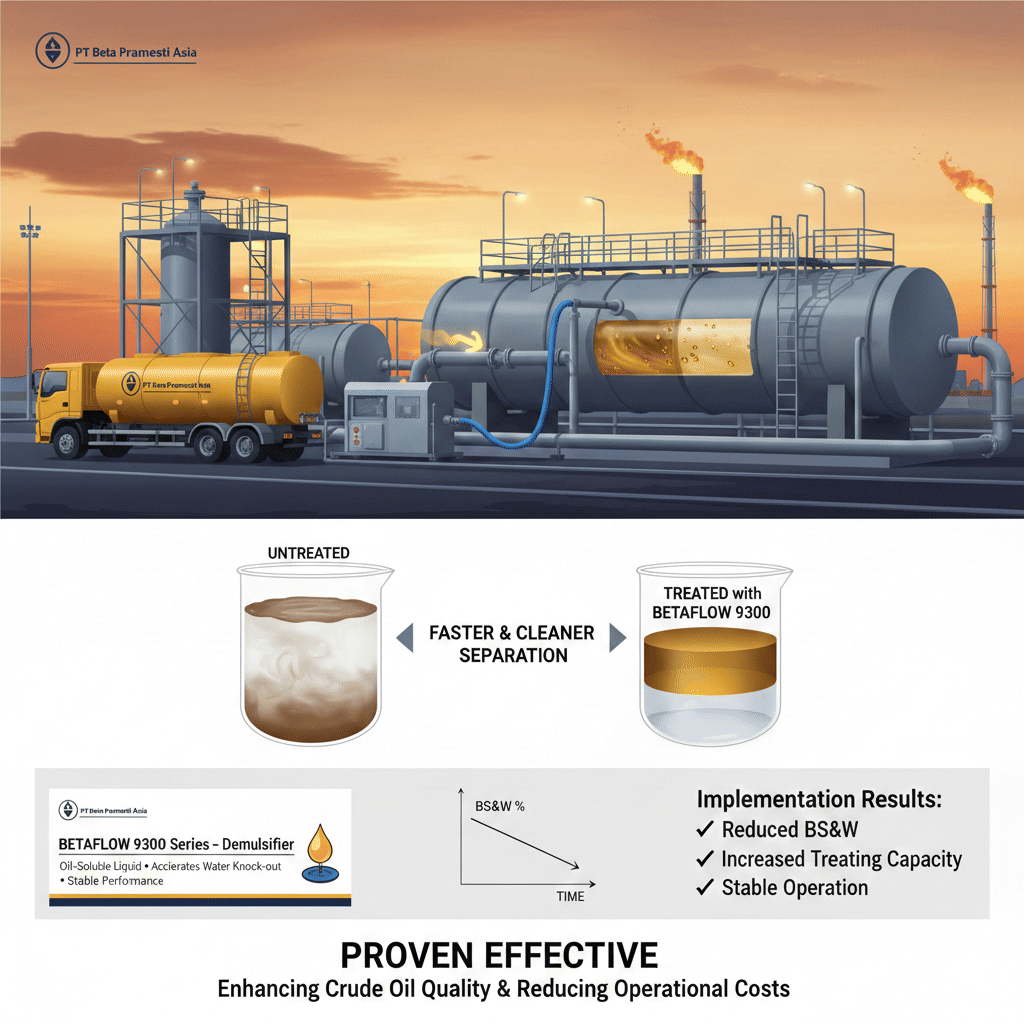
Crude oil–water separation optimization with BETAFLOW 9300 Series reduced Basic Sediment & Water (BS&W), shortened separation time, and increased effective treating capacity at the facility in this study without major equipment modifications.
Last technically reviewed: 28 July 2026.
How to verify crude oil–water separation in a field trial
A demulsifier programme should be accepted from a controlled field comparison, not a bottle-test result alone. Record fluid condition, chemical control, separator operation, and product quality on the same time basis; then confirm that lower BS&W and faster separation persist when flow, temperature, water cut, and emulsion character change.
| Trial evidence | Data to record | Acceptance requirement |
|---|---|---|
| Produced-fluid baseline | Crude and water characteristics, temperature, flow, water cut, emulsion stability, BS&W, and residence time | The baseline covers representative operating conditions before the chemical change |
| Chemical control | Product and batch, solution condition, calibrated injection rate, location, mixing, and contact time | Actual dose is traceable and repeatable at the measured production rate |
| Separation performance | BS&W, interface quality, separated-water condition, separator level, carryover, and residence time | Oil and water phases meet the facility’s agreed quality and operating limits |
| Capacity and stability | Throughput, alarms, off-spec events, chemical use, and response to changing field conditions | Improvement is sustained without transferring instability to downstream equipment or water handling |
Industry
Oil and Gas Industry
Challenge
The crude oil production facility encountered persistent oil–water emulsions in its produced fluids. These stable emulsions resulted in elevated Basic Sediment & Water (BS&W) content, extended separation times, limited effective treating capacity, and increased operational costs.
The condition also introduced risks to crude oil quality and hindered overall process throughput. The facility required a robust chemical solution capable of restoring efficient separation performance while maintaining reliable operation and compliance with applicable industry standards.
Results
Following the deployment of BETAFLOW 9300 Series, the facility achieved substantial improvements in oil–water separation performance.
The key outcomes included:
- Significant reduction in BS&W levels.
- Faster and cleaner oil–water separation.
- Shorter residence times in separators and gun barrel tanks.
- Increased effective treating capacity.
- Stable and reliable production performance.
- Reduced risk to crude oil quality.
- No major equipment or process modifications required.
Key Product
BETAFLOW 9300 Series
BETAFLOW 9300 Series is an oil-soluble demulsifier developed to break stable crude oil emulsions and accelerate the separation of water from produced oil. Its application supports improved crude quality, higher treating efficiency, and more reliable upstream production operations.
Review the BETAFLOW demulsifier product series when preparing bottle-test data, injection conditions, packaging, and a field-optimisation request.
Where wax and paraffin deposition restricts crude-oil transport rather than separation, see the BETAFLOW 9500 pipeline flow-assurance case study.

About Beta Pramesti Asia
PT Beta Pramesti Asia is a chemical solutions provider specializing in oil and gas production chemicals. The company provides innovative chemical treatment programs designed to improve fluid separation, production reliability, asset performance, and operational efficiency.
The Challenge
The onshore crude oil production facility experienced complex operational disruptions caused by stable oil–water emulsions in its produced fluids.
The persistent emulsions contributed to high Basic Sediment & Water levels in the crude oil. They also prolonged separation durations in both the main separators and gun barrel tanks.
As separation performance declined, the effective capacity of the facility’s treating equipment became increasingly limited. This condition affected production throughput, raised operational costs, and introduced additional risks to crude oil quality.
The facility therefore required an efficient and technically sound treatment program capable of:
- Breaking persistent oil–water emulsions.
- Lowering BS&W levels in the treated crude oil.
- Reducing separation and residence times.
- Restoring effective treating capacity.
- Maintaining stable production across varying field conditions.
- Avoiding major equipment modifications.
The Solution
The facility’s technical team partnered with PT Beta Pramesti Asia to evaluate the field conditions and determine the most suitable demulsifier treatment program.
The technical evaluation considered several important operating parameters, including:
- Produced fluid temperature.
- Crude oil and water characteristics.
- Emulsion stability.
- Production flow rates.
- Separator and treater configuration.
- Chemical injection location.
- Existing operating conditions.
Based on the field assessment, the team recommended BETAFLOW 9300 Series, an oil-soluble demulsifier engineered for rapid and effective water removal from crude oil.
The product was injected upstream of the main separator to provide adequate mixing and contact time before the produced fluid entered the primary separation equipment.
Field testing was then conducted to optimize the chemical dosage. The optimization process ensured that the treatment remained compatible with the existing facility configuration while delivering stable separation performance across changing production conditions.
The Results
The implementation of BETAFLOW 9300 Series delivered measurable improvements across several critical operating indicators.
The facility observed a significant reduction in BS&W levels, resulting in cleaner crude oil and reduced risk of off-specification production.
Oil and water separated more rapidly and formed a cleaner interface inside the treating equipment. This improvement shortened the required residence time in the separators and gun barrel tanks.
Faster separation also increased the effective capacity of the existing treating system, allowing the facility to process produced fluids more efficiently without installing major new equipment.
Overall operational improvements included:
- Reduced BS&W in treated crude oil.
- Faster emulsion breaking.
- Cleaner oil and water phases.
- Shorter separation residence time.
- Higher effective treating capacity.
- More stable separator operation.
- Improved crude oil quality control.
- Reduced operational and maintenance costs.
- No major modifications to existing equipment.
These results demonstrate the effectiveness and versatility of BETAFLOW 9300 Series for oil–water separation applications in upstream oil and gas production facilities.
Customer Testimonial
“Before using BETAFLOW 9300 Series, our onshore crude oil production facility was facing persistent oil–water emulsion issues. The emulsion was very stable, resulting in high BS&W levels, extended separation time in separators and gun barrel tanks, and reduced effective treating capacity. These conditions directly impacted our operating efficiency and crude oil quality.”
Mansour
Project Manager
Ready to Improve Oil–Water Separation?
Improve crude oil quality, reduce BS&W, shorten separation time, and increase the effective capacity of existing treating equipment with BETAFLOW 9300 Series.
For separated water that still contains free or emulsified oil, evaluate an industrial wastewater oil-removal process based on oil form, TSS, effluent target, and sludge route. Contact PT Beta Pramesti Asia to discuss a chemical treatment program tailored to your crude oil characteristics, production conditions, and separation equipment.
Buyer questions about crude oil–water separation
Which data are needed before a demulsifier field trial?
Prepare crude and water characteristics, temperature, flow, water cut, BS&W, emulsion stability, residence time, separator configuration, current product and dose, injection point, sampling method, target crude quality, and separated-water condition. The baseline should represent normal operation and the upset being addressed.
Does a higher demulsifier dose always accelerate separation?
No. Performance depends on formulation fit, actual dose, mixing, injection point, contact time, temperature, and emulsion character. Overdosing can increase cost or disturb the interface, so the decision should follow controlled bottle and field trials.
When is separation-equipment modification still necessary?
Chemistry cannot replace adequate volume, temperature, level control, residence time, and mechanical condition. Modification should be evaluated when the separator is undersized, flow distribution is poor, heating is insufficient, interface level is unstable, or downstream problems remain after chemical optimization.