

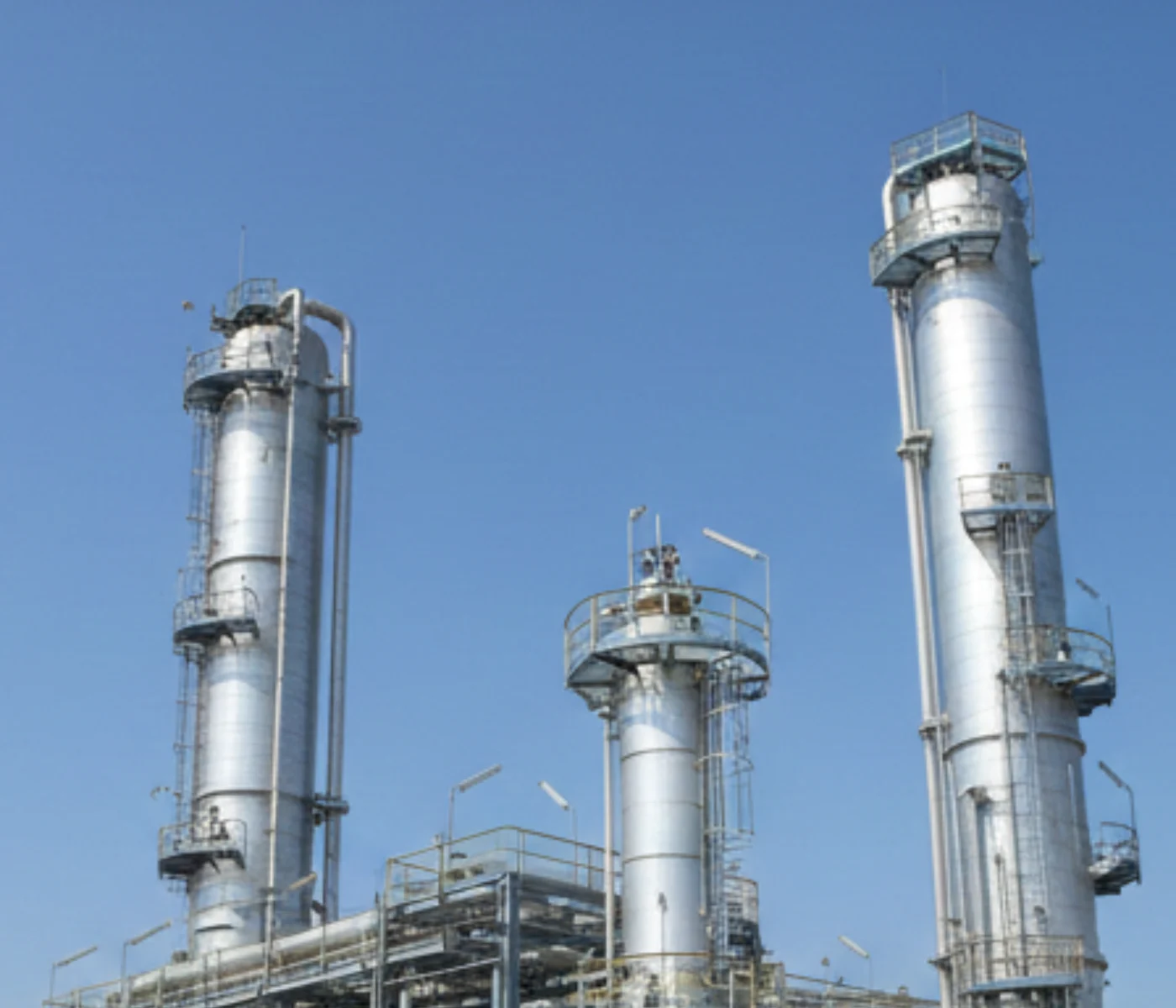
Natural gas CO2 removal optimization with BETAFLOW 9850 Series cut amine circulation by 30% and reboiler energy by 25% at the facility in this study. The system changed from 20 wt% MEA to 45 wt% formulated MDEA, increased treating capacity, and retained its major equipment.
Last technically reviewed: 28 July 2026.
Industry
Oil and Gas Industry
Challenge
A natural gas processing facility was treating feed gas containing approximately 8 mol% CO₂ with a conventional 20 wt% MEA system. High amine circulation and reboiler energy demand increased operating costs, while corrosion in the absorber and regenerator raised maintenance requirements and constrained additional processing capacity.
Results
After implementing Betaflow 9850 Series at 45 wt% concentration, the facility reduced amine circulation by 30% and reboiler energy consumption by 25%. Corrosion was better controlled, maintenance requirements decreased, and natural gas processing capacity increased. No major equipment modifications were required.
Key Product
Betaflow 9850 Series amine treatment is a formulated MDEA-based solvent developed for efficient acid gas removal. In this application, it enabled the facility to reduce solvent circulation and regeneration energy while continuing to use the existing gas treating equipment.
About the Company

PT Beta Pramesti Asia provides gas treating solutions and specialty chemicals for the energy industry. The company supports industrial customers in improving process efficiency, equipment reliability, operational safety, and long-term system performance.
The Challenge
The natural gas processing facility faced persistent performance limitations while treating feed gas containing approximately 8 mol% CO₂.
Its existing amine system used 20 wt% MEA. Although the system provided the required gas treatment function, it demanded substantial reboiler energy and a high amine circulation rate. The facility also experienced elevated corrosion in the absorber and regenerator, increasing inspection and maintenance requirements and creating concerns about equipment reliability.
The primary operational challenges included:
- High reboiler energy demand
- Excessive amine circulation
- Corrosion in the absorber and regenerator
- Increasing maintenance requirements
- High operating expenditure
- Limited capacity for additional gas throughput
- Dependence on the existing equipment configuration
The facility needed a solvent solution that could improve CO₂ removal efficiency while allowing the existing gas treating equipment to remain in service.
The Solution
After reviewing the process conditions and evaluating alternative solvent technologies, the facility selected Betaflow 9850 Series, a formulated MDEA-based solvent developed for efficient acid gas removal.
The facility implemented Betaflow 9850 Series at 45 wt% concentration. The transition required only minor adjustments to operating temperature and pH controls. No major equipment modifications were necessary, minimizing implementation costs and avoiding the extended downtime associated with substantial mechanical upgrades.
The implementation focused on:
- Optimizing solvent concentration
- Reducing unnecessary amine circulation
- Lowering reboiler energy requirements
- Improving operating stability
- Controlling corrosion within the amine system
- Preserving the existing absorber and regenerator configuration
The Results
After adopting Betaflow 9850 Series, the facility recorded measurable improvements across the natural gas treating process.
Amine circulation decreased by 30%, allowing the system to maintain the required gas treatment performance with a lower circulating solvent volume. This reduced the load on circulation equipment and created additional capacity within the existing process.
Reboiler energy consumption decreased by 25%, reducing utility demand and improving operating economics. Corrosion rates in the absorber and regenerator also declined significantly, reducing maintenance demands and supporting more reliable operation of the existing equipment.
The optimized system increased natural gas processing capacity without major capital modifications.
Key Operational Improvements
| Performance indicator | Result |
|---|---|
| Feed gas CO₂ concentration | Approximately 8 mol% |
| Previous solvent | 20 wt% MEA |
| Betaflow 9850 Series concentration | 45 wt% |
| Amine circulation reduction | 30% |
| Reboiler energy reduction | 25% |
| Corrosion condition | Significantly reduced |
| Major equipment modification | Not required |
| Processing capacity | Increased |
| Overall OPEX | Reduced |
These improvements enabled the facility to achieve a more efficient balance between CO₂ removal performance, energy consumption, equipment reliability, and operating costs.
Customer Testimonial
“After switching from 20 wt% MEA to Betaflow 9850 Series, we experienced a significant improvement in our CO₂ removal operations. Reboiler energy consumption decreased noticeably, amine circulation rates were reduced, and the corrosion issues previously observed in the absorber and regenerator are now much better controlled.
What we value most is that implementing Betaflow 9850 Series did not require major modifications to the existing equipment, allowing for a fast and safe transition.
With more stable performance and improved operational efficiency, Betaflow 9850 Series has helped us reduce OPEX while increasing unit capacity. The product has proven to be highly reliable for our natural gas treating applications.”
Improve the Efficiency of Your Gas Treating System
Betaflow 9850 Series can help natural gas processing facilities optimize acid gas removal, reduce solvent circulation, lower regeneration energy demand, and control corrosion without requiring major changes to existing equipment.
Also compare the oil and gas production chemical range for corrosion, scale, emulsion, foam, and flow-assurance needs outside the amine-solvent scope. Contact PT Beta Pramesti Asia to discuss your natural gas composition, amine system conditions, operational challenges, and treatment objectives.
Buyer questions about CO2 removal optimization
What data is needed to assess a CO2 removal optimization?
Provide feed and treated-gas composition, gas flow, absorber and regenerator conditions, solvent type and concentration, circulation rate, reboiler duty, lean and rich loading, corrosion history, foaming events, filtration performance, and sales-gas specification. These inputs define whether solvent reformulation, operating changes, or equipment work should be evaluated.
Do the 30% circulation and 25% energy reductions apply to every unit?
No. Those figures belong to the facility in this case study. Results elsewhere depend on gas composition and flow, CO2 and H2S targets, absorber-regenerator configuration, solvent condition, utilities, corrosion, and equipment hydraulic limits.
When should a facility evaluate an amine-solvent change?
An evaluation is warranted when circulation or reboiler duty is high, corrosion and foaming recur, treated gas is difficult to keep on specification, or the amine system limits unit capacity. The decision still requires mass and energy balances, equipment checks, material-compatibility review, and an operating transition plan.