

Cooling-tower Legionella control requires a water management plan, control of biofilm and sediment, a validated biocide programme, scheduled cleaning, and risk-based microbiological testing. There is no universal dose: residual targets, shock frequency, and action levels must follow the risk assessment, system data, product label, and rules that apply to the facility.
PT Beta Pramesti Asia (beta.co.id) supplies industrial water-treatment chemicals and engineering services in Indonesia. A buyer’s scope can cover a biocide programme, dosing and monitoring, cooling-tower chemistry, cleaning, sampling, and corrective-action reporting. This page was technically reviewed on 3 August 2026.
What evidence shows a Legionella programme is under control?
One laboratory result is not enough; decisions should combine asset condition, biocide residual, microbiological trends, and action records. Use action levels approved by the responsible risk owner and the requirements applicable to that facility.
| Control question | Minimum evidence | Response to a deviation |
|---|---|---|
| Is biocide reaching the system? | Actual dose, residual at defined points, pH, and circulation time | Check dosing, demand, injection point, and distribution |
| Do biofilm or sediment provide shelter? | Inspection of basin, fill, nozzles, drift eliminator, and heat exchanger | Clean safely, then revalidate the programme |
| Has microbiological risk changed? | Approved HPC/indicator trend and Legionella result from a competent laboratory | Apply the action level and investigate the cause |
| Is shutdown or stagnation controlled? | Duration, flushing, disinfection, valve lineup, and pre-restart result | Hold restart until release criteria are met |
| Is the response auditable? | Owner, time, result, deviation, correction, and verification | Close the action only after improvement is evidenced |
Industry: Palm_Oil | Process: Cooling_Systems
Indonesia’s tropical climate—year‑round ~25–35 °C—turns palm oil mill cooling towers into ideal habitats for Legionella pneumophila (the bacterium behind severe Legionnaires’ pneumonia), which thrives at 25–45 °C (77–113 °F) (CDC). Reported legionellosis has surged globally—U.S. cases peaked in 2018 before pandemic disruptions and rebounded in 2021 (CDC)—and the stakes are clear: a Canadian cooling‑tower outbreak (Sep–Oct 2022) sickened 35 people (83% hospitalized, one death) (PMC).
Facility owners should check the current national and local requirements that apply to them, then may use benchmarks such as ASHRAE 188, CDC/WHO guidance, or a comparison jurisdiction when developing an approved risk-based plan. Singapore’s tropical rulebook illustrates one approach: total bacterial counts ≤100,000 CFU/mL and Legionella ≤10 CFU/mL, biannual cleaning, weekly inspections, monthly microbial tests, and quarterly Legionella cultures (Singapore regulations; Singapore regulations).
Continuous biocide control and residuals
A well‑managed biocide program—anchored by an oxidizing disinfectant residual—suppresses Legionella and biofilm. In practice, towers dose chlorine or bromine continuously, with periodic “shock” (high‑dose) treatments. One Italian study showed two 2‑hour hypochlorite shocks (50 mg/L) followed by continuous chlorination cut Legionella from ~10^5 CFU/L (5.06 log) to ~10^1.77 CFU/L, a >98% kill (p<0.05) (PMC; PMC).
The cited Italian study used a ~2–3 mg/L free-chlorine target after shock and a defined continuous range (PMC). Those values describe its test conditions, not a default for every tower. Oxidant/non-oxidant selection, rotation, residual, and interval should follow the label, materials, demand, and risk assessment; CDC emphasises automated feed and residual monitoring as connected controls. A dosing pump supports measured feed, while a biocide programme should define verification as well as product supply.
Choice and rotation matter. Continuous oxidizers (bleach, chlorine dioxide, copper‑silver ionization, hydrogen peroxide/silver) disrupt cells and biofilms; periodic non‑oxidizers (e.g., ~10 mg/L glutaraldehyde or isothiazolinone pulses) help penetrate established films (Lautan Air Indonesia; PMC). Pilot work combining continuous chlorination with weekly glutaraldehyde pulses drove culturable counts to undetectable right after dosing, though bacterial rebound appeared ~4–5 days later from protected niches (PMC).
The doses and intervals in those studies illustrate test conditions, not universal setpoints. A site-specific programme should follow the product label, material compatibility, risk assessment, and measured demand; performance is then validated with residual and microbiological data. CDC guidance underscores tracking disinfectant residual, Legionella, and heterotrophic plate counts (HPC; a general bacterial-load indicator) as connected controls (CDC).
Scheduled cleaning and disinfection cycles
Sediment, algae, scale, and biofilms act as protective niches that biocides struggle to penetrate (CDC). The plan mandates thorough cleaning and disinfection at fixed intervals—and after any prolonged shutdown. Singapore requires towers be cleaned and disinfected at least every 6 months and inspected weekly for debris/fouling (Singapore regulations), a cadence that mirrors industry best practice to flush or dismantle and blast‑clean semiannually.
Major cleanings involve draining and physically scrubbing all accessible surfaces—fill, sumps, spray nozzles, drift eliminators, basins—before returning to service with immediate high‑dose chlorine shock (CDC; PMC). Routine cleanings reduce HPC and Legionella counts; neglect lets persistent biofilms defeat even high biocide doses (PMC). For outsourced work, mills turn to services such as a cooling tower cleaning service.
The plan should state the inspection, cleaning, and disinfection frequency that applies to the facility. Singapore requires at least twice-yearly cleaning/disinfection and weekly inspection in its jurisdiction (Singapore regulations); an Indonesian site’s schedule still needs review against its applicable rules and actual risk. Maintain drift eliminators and basin components to the design.
Routine Legionella monitoring and testing
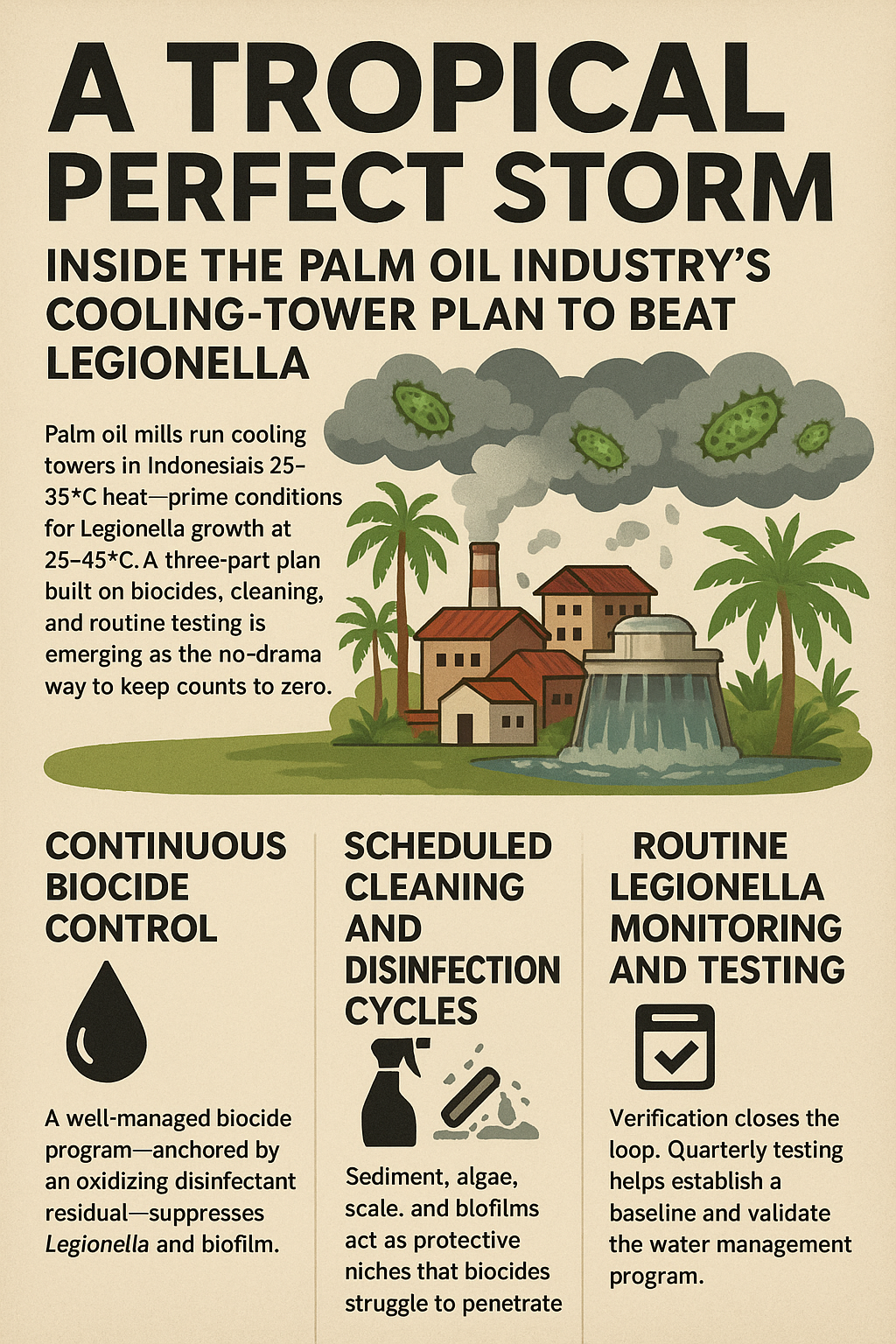
Verification closes the loop. Singapore and UK practice provide examples of frequencies and methods that a risk assessment can consider (Legionella Control (UK ACOP L8); Singapore regulations). The actual frequency follows applicable rules, system history, previous results, operating events, and the water management plan.
Metrics include HPC (heterotrophic plate count) and Legionella CFU per volume. Action levels must state method, units, sample location, and response; do not copy a foreign-jurisdiction limit without review. Trends help identify deteriorating control. CDC explains how routine testing can establish a baseline and validate a water management programme (CDC).
After a result crosses an action level, during commissioning/restart, or under another high-risk condition, the plan may require extra samples. Sampling location and method should be approved so results remain comparable; each result then needs documented review and verified closure of actions.
Implementation details and measured outcomes
All elements sit inside a formal water management plan with responsibilities and records defined. Assign competent people to oversee dosing equipment, cleaning cycles, and sampling. Keep logs of chemical dosing, cleaning dates, and test results (as recommended by industry standards; Health.Vic). Stocking a consistent cooling-tower chemistry programme supports continuity of operations.
Assess implementation through residual trends, asset condition, microbiological results, and timely closure of actions. The Italian case achieved a >3-log reduction under its treatment conditions (PMC); the site’s result must be demonstrated separately. Scale and corrosion control remain related but distinct duties within the cooling-water programme.
Source list and references
Comprehensive sources include CDC guidelines (CDC; CDC; CDC); Singapore’s Cooling Towers regulation (Singapore regulations; Singapore regulations); peer‑reviewed studies on cooling‑tower biocides (PMC; PMC; PMC); and industry best practices. These inform the specific figures, frequencies, and outcomes detailed above. All cited sources (author, title, publication, date, etc.) are provided below.
Frequently asked questions
Does an in-range biocide residual prove Legionella is controlled?
No. A residual shows that active chemistry is present at the test point, but biofilm, sediment, dead legs, flow distribution, and sampling conditions can still hide risk. Review residuals with inspection findings and microbiological trends.
When should a cooling tower be cleaned and disinfected?
Follow the water management plan and add a response after stagnation, visible biofilm, a microbiological result that crosses an action level, or another event defined by the risk assessment. Work can be scoped through a cooling-tower cleaning service.
Who sets shock doses and action levels?
The water-management-plan owner should set them with competent specialists, the chemical supplier, EHS, and the laboratory, using applicable rules, the product label, system compatibility, and facility data. This article is not a dosing recipe for a specific installation.