

Semiconductor manufacturing is surging toward water use that could double by 2035 — and it’s leaving behind some of industry’s most variable, toxic wastewater. Here’s how fabs are designing centralized treatment plants that neutralize acids, precipitate metals and fluoride, polish ions, and filter to near‑zero discharge.
Industry: Semiconductor | Process: Wafer_Fabrication
A modern multi‑fab campus can drink like a small city. Intel’s Ocotillo site withdraws about 53,000 m³/day (14 MGD; MGD, million gallons per day) semiengineering.com. A single advanced fab “use[s] millions – or even tens of millions – of gallons of water per day” samcotech.com. Industry forecasts say semiconductor water use will double by 2035, reflecting a skyrocketing market; TSMC alone used ~101×10^6 m³ in 2023 idtechex.com.
As demand rises, fabs generate proportionally more wastewater. In Korea, semiconductor processes produced ~177,937 m³/day by 2019, or ~19.3% of all industrial effluent researchgate.net. Much of this is happening in water‑stressed regions like Taiwan and the U.S. Southwest, which is driving aggressive reuse and ultra‑stringent treatment goals idtechex.com semiengineering.com.
Variable, toxic wastewater chemistry
Fab wastewater blends streams from photolithography, etch, deposition, CMP (chemical mechanical planarization), and cleaning — each with different chemistry. Typical constituents include strong acids (HF, HCl, H₂SO₄, HNO₃, H₃PO₄), alkalines (e.g., NH₄OH), metal salts (Cu, Zn, Ni, Fe, Al, Co, etc.), chelating agents (e.g., PBTC, cyanide), peroxide/ozone, organics (photoresist solvents like IPA), silica, and suspended particles samcotech.com researchgate.net.
One study found scrub wastewater with pH ≈2.2, F ≈460 mg/L, sulfate >15,000 mg/L, NH₄‑N ≈11 mg/L, total P ≈2.5 mg/L, SiO₂ ≈10 mg/L, and Fe ≈22 mg/L researchgate.net researchgate.net. As Sim et al. note, “various acidic chemicals…lead to the generation of acidic wastewater containing harmful substances,” and uncontrolled discharge can “impose[] a significant environmental burden” researchgate.net.
Global regulators mandate very low effluent levels — “government regulations set limits on containment levels that are environmentally safe to discharge” semiengineering.com. In Indonesia, an operating permit (Technical Approval) requires compliance with Ministry of Environment and Forestry numeric effluent standards (pH, BOD, COD, heavy metals, etc.), and until updated, current MoEF Reg.5/2014 standards apply enviliance.com enviliance.com. To meet typical Class I discharge limits, fabs often target TSS < 30 mg/L, BOD₅ < 20 mg/L, Cu/Zn/Pb/Ni well below 0.1–0.2 mg/L, and F⁻ at a few mg/L.
Centralized treatment train architecture
A robust, flexible centralized plant typically uses a multi‑stage train: (1) equalization (flow/pH buffering); (2) pH neutralization; (3) chemical precipitation/coagulation; (4) ion exchange polishing; (5) advanced filtration (membranes/carbon). Real‑time sensors and DCS controls adjust chemical dosing as influent chemistry shifts, and modular parallel reactors with spare capacity keep uptime high.
Good design practice is to reduce peak flows via equalization basins by ~40–60%, easing downstream load porvoo.com.cn. Fabs often segregate streams (e.g., highly contaminated etch vs. cleaner rinse) so the central plant sees a more uniform mixture, but the central system still must handle worst‑case blends semiengineering.com.
Figure: Centralized fab wastewater is treated via a multi‑stage plant. Key steps (pH neutralization, precipitation, exchange, filtration) are applied in series to handle the broad contaminant mix and variable loads.
Equalization and pH neutralization
An initial equalization tank with mixing evens out pH and flow swings. Automatic pH controls add alkaline (e.g., NaOH or flakes) to very acidic blends, or acid (e.g., H₂SO₄) to highly alkaline streams, targeting near‑neutral conditions before downstream steps. Accurate dosing is typically delivered by a dosing pump to maintain stable setpoints.
Lime (Ca(OH)₂) is the workhorse for HF‑rich etch effluent. Raising pH from ~2 to neutral/alkaline forms CaF₂; one study achieved 99% fluoride removal at a Ca:F molar ratio ≈1.6 researchgate.net. pH control also sets up metal removal: many metal hydroxides (Cu, Zn, Ni, etc.) become insoluble around pH 8–10 intechopen.com. In practice, simultaneous precipitation can remove >95% of metals; e.g., a pH ~10.3 lime treatment yielded ~99% removal of several heavy cations in 15 minutes intechopen.com. Two‑stage precipitations (lower/high pH) are used for mixed metals if needed.
Chemical precipitation and solids separation
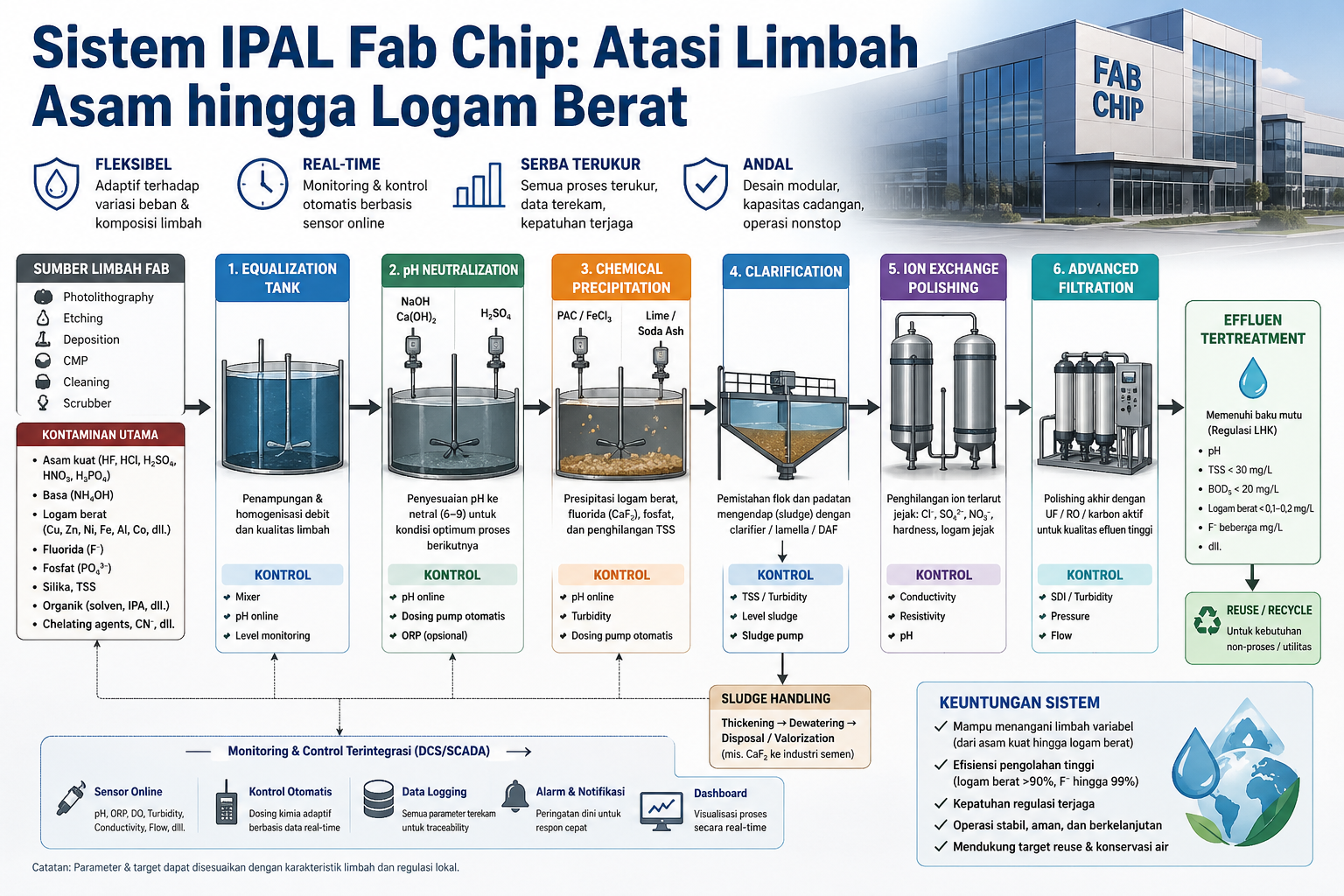
After neutralization, precipitation/coag tanks add coagulants such as FeCl₃ or PAC to floc colloids and oxidize/remove organics. For industrial wastewater duty, plants often deploy PAC for industrial treatment to improve floc strength. Additional lime or soda ash drives out residual metals and hardness as insoluble salts by raising pH into the range of minimal metal hydroxide solubilities.
Heavy metals (Cu²⁺, Zn²⁺, Ni²⁺, Fe³⁺, etc.) drop sharply above pH ≈8, and reaching pH ~10–11 can remove 90–99% of these metals intechopen.com intechopen.com. Phosphates are removed by Fe/Al coagulants. Fluoride is precipitated as calcium fluoride with Ca(OH)₂ at Ca:F ~1.5–2, achieving near‑complete (99%) removal; the CaF₂ byproduct can be recovered (cement manufacture), and residual soluble F can be polished by resin researchgate.net.
Silica and arsenic (if present) can be co‑precipitated at high pH or filtered; silicic acid often remains dissolved and may require separate UF/adsorption. Overall, chemical precipitation removes ~80–95% of TSS and >90% of regulated metals. Sludge settles in compact clarifiers; a lamella settler reduces footprint, while a DAF unit accelerates separation for short detention times.
Embedded image: A settling tank (clarifier) after precipitation, where flocculated metal hydroxides and calcium fluoride separate as sludge. (In practice, a lamella clarifier or DAF unit is often used for speed and compactness.) pixabay.com
Ion exchange polishing
Clarified effluent still carries residual ions — often sub‑mg/L levels of Cu/Zn, hardness (Ca/Mg), nitrates, sulfate, chloride — that must be reduced for tight discharge or reuse. An ion exchange system using strong‑acid cation and strong‑base anion resins, often arranged as a mixed bed, can polish to ultra‑trace levels suitable for sensitive loops.
For recycled rinse water or final polishing, fabs commonly use a mixed-bed ion exchanger. In discharge duty, IX can remove >90–95% of remaining hardness, silica, phosphates, and heavy ions, often down to <0.1 mg/L. One plant reported cutting chloride and metal ions from tens of mg/L to single‑digit µg/L (ppb). Resins are regenerated with acid (cation) and caustic (anion), with regenerant waste neutralized and precipitated or recycled. While IX has higher operating cost, it is invaluable for meeting “zero discharge” constraints for onsite reuse loops samcotech.com.
Advanced filtration and adsorption
Membrane and adsorbent polishing removes the last particulates and organics. UF (ultrafiltration) modules — often installed as a dedicated ultrafiltration pretreatment line — strip colloids and nano‑flocs, reducing turbidity to near zero. Activated carbon beds adsorb trace organics (e.g., residual solvents, TOC); a dedicated activated carbon system also offers incidental adsorption of some metals such as Ni.
For high‑grade reuse, RO (reverse osmosis) can remove >95% of dissolved salts (Na⁺, Cl⁻, SO₄²⁻) and any last contaminants, producing demineralized permeate. Fabs typically install a brackish-water RO for feeds with moderate TDS (total dissolved solids). RO reject (concentrate) is sent back to IX or to evaporation crystallizers. Modern fabs even pilot electrodialysis or membrane distillation, though a conservative design often pairs RO with IX (RO+IX). U.S. water regulators for new fabs (e.g., Phoenix) are already requiring RO pretreatment before sewer discharge semiengineering.com.
Combined effects are strong: MF/UF can remove ~99% of particulates and bacteria porvoo.com.cn, RO/IX >98% of ions, carbon ~90% of methanol/IPA, and oxidation (if used) >90% for organics. Final effluent typically shows TDS in the low hundreds mg/L, metals in µg/L, and negligible BOD/COD. Integrated membrane blocks are often specified as complete membrane systems for industrial duty.
Performance metrics and outcomes
A benchmark centralized plant can achieve “>95%” removal of target metals and organics. In one trial, optimized precipitation and IX brought all tested metals from 10–50 ppm down to sub‑0.1 ppm intechopen.com. Another facility raised internal water reuse from ~30% to ~65% by upgrading the train, avoiding ~$30 million of new water system capital investment in the process semiengineering.com.
Compliance is built in: typical outcomes show pH ~6.5–9, BOD/COD near zero, TSS < 30 mg/L, and metal/discharge ions below legal limits. Many fabs target near‑zero discharge, reusing recovered water as scrub makeup or coolant, with only an essential bleed. Byproducts help offset cost: the CaF₂ precipitate and, after treatment, ammonium sulfate can be sold or used (cement, fertilizer) samcotech.com.
Operations, monitoring, and standards
Operating targets are explicit: pH regulated to ~7.0±0.5; fluoride < 2 mg/L (target < 1 ppm) after treatment; heavy metals < 0.1 ppm each; TSS < 30 mg/L. Plants deploy continuous monitors for pH, conductivity, and specific metals (e.g., Cu/Zn analyzers), with periodic ICP‑MS and TOC testing to verify performance. Many fabs add online UV/TOC and metal probes to dynamically adjust dosing.
Meeting Indonesian MoEF standards — including the current Reg.5/2014 limits pending updates — is routine with this approach enviliance.com enviliance.com. Instrumentation, metering, and controls are typically packaged as supporting ancillaries to integrate seamlessly with the treatment train.
Sources and further reading
Core data and design guidance are drawn from recent industry and research publications on semiconductor fab wastewater treatment sciencedirect.com researchgate.net researchgate.net semiengineering.com, as well as case examples and regulatory summaries enviliance.com semiengineering.com idtechex.com. Additional references include detailed precipitation and IX performance notes researchgate.net intechopen.com and reuse practices samcotech.com samcotech.com. Clarification and membrane performance benchmarks are noted here porvoo.com.cn porvoo.com.cn.