

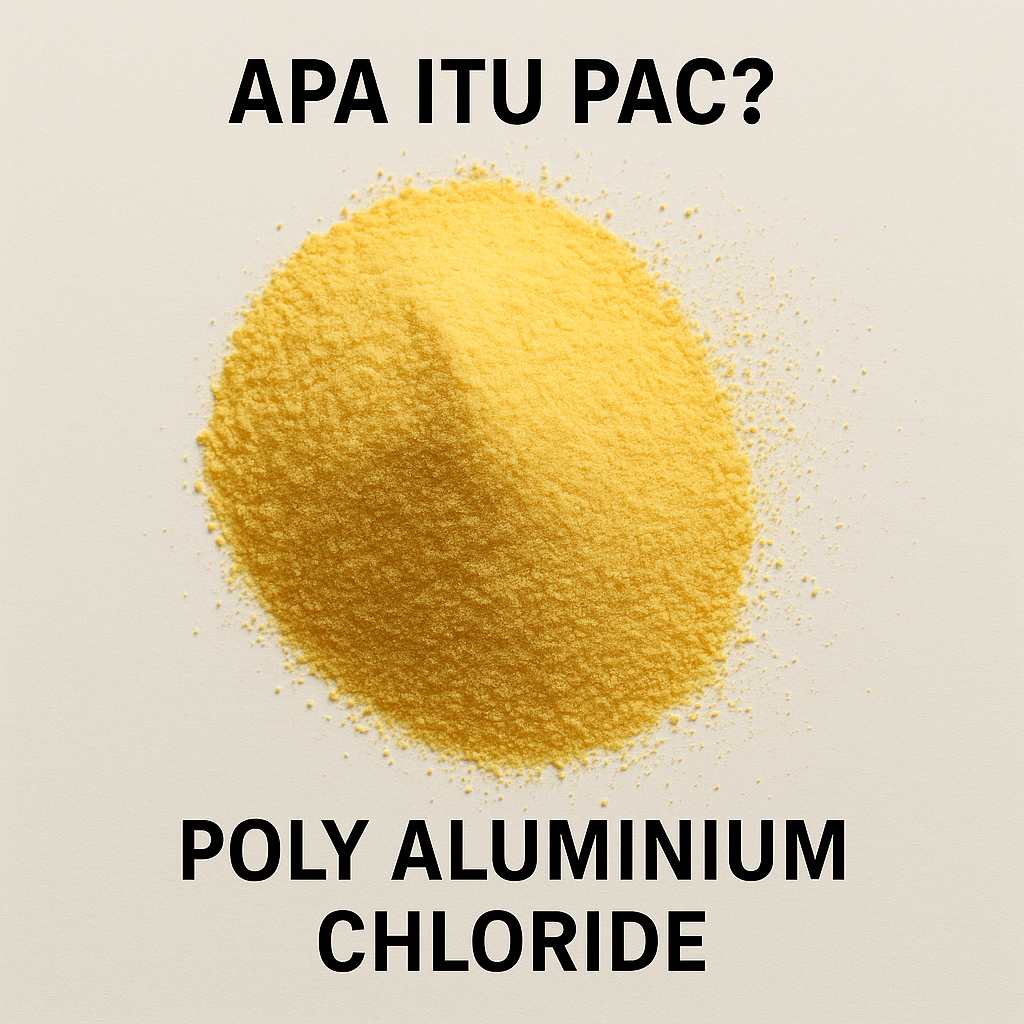
PAC for Water and Wastewater Treatment
PAC for water treatment is Poly Aluminum Chloride, an aluminum coagulant that neutralizes colloidal-particle charge so separable flocs can form. WTP and WWTP operators test PAC to reduce turbidity, TSS, color, and the coagulable organic fraction before settling, DAF, or filtration.
PT Beta Pramesti Asia, operating through beta.co.id, supplies PAC and supports coagulation evaluation for industrial water and wastewater treatment plants in Indonesia.
This article explains the definition, working mechanism, product forms, applications, and process data to prepare before selecting PAC, industrial liquid PAC, or a combined coagulants and flocculants program.
Last technically reviewed: 8 August 2026.
What is PAC?

PAC stands for Poly Aluminum Chloride, an aluminum-based coagulant that destabilizes colloidal particles so they can form floc. Products are supplied as powder or liquid, with active content, basicity, pH, and density varying by grade.
PAC and alum both need testing on the actual water. Compare pH and alkalinity change, effective dose, floc strength, separation rate, and sludge production before changing coagulants.
History and Background of PAC
Aluminum coagulants such as alum were used to clarify water before PAC. PAC later gained broad use in water treatment and industrial processes, but comparisons with alum should not be generalized: dose, pH shift, floc-formation rate, and sludge production depend on coagulant grade and the water being tested.
Composition and Characteristics of PAC
PAC is normally supplied as powder or liquid. Select the supply form from consumption, make-down facilities, tank space, handling capability, and chemical cost per cubic metre treated; product colour does not identify the correct grade.
| PAC form | When it may fit | Facilities to prepare | Data to compare |
|---|---|---|---|
| Powder | Storage and transport favour a higher mass concentration, and operators can prepare a consistent solution | Dry storage, handling equipment, a make-down tank, an agitator, and solution-concentration control | Al₂O₃ content, basicity, insoluble matter, dissolving time, make-down concentration, and cost per m³ |
| Liquid | Continuous feed without powder make-down better matches plant operation | A compatible tank, secondary containment, piping, seals, and pump | Al₂O₃ content, basicity, density, product pH, storage stability, and cost per m³ |
For drinking-water duty, review the grade and product documents for liquid PAC for drinking water. For process water or industrial wastewater, compare plant requirements with industrial liquid PAC.
Important characteristics of PAC:
- Al₂O₃ content and basicity confirmed in the product specification.
- pH and density that vary by form and grade.
- Insoluble matter checked for product quality and dosing-system reliability.
- Coagulation performance demonstrated on the actual water by jar testing.
How PAC Works in Water Treatment
PAC works through two main processes:
- Coagulation
Aluminum ions in PAC neutralize the negative charge on colloidal particles. Because the charge is gone, the dirt particles no longer repel, but instead draw closer to each other. - Flocculation
Once the charge is neutralized, the particles will combine to form large clumps (flocs). These flocs are heavier and settle easily, so they can be separated from the water.
The result is a separable floc. Final clarity and separation time still depend on dose, mixing energy, water characteristics, and the capacity of the settling or filtration stage.
Benefits of PAC in Various Sectors
1. Drinking Water Treatment
PAC is widely used by PDAMs and private drinking water companies to produce clean water that is suitable for consumption.
2. Industrial Liquid Waste Treatment
For textile, paper, food, or petrochemical wastewater, PAC can be tested to capture TSS, color, emulsified oil, or the coagulable organic fraction. COD/BOD reduction depends on wastewater composition and must be demonstrated by testing. Review the available wastewater treatment equipment only after defining the separation target.
3. Household Wastewater Treatment
In domestic wastewater, PAC only addresses the fraction that can be separated by coagulation; biological treatment and disinfection are still selected from wastewater characteristics and the effluent target. A compact sewage treatment plant therefore needs a complete process review, not a coagulant decision alone.
4. Paper and Textile Industry
PAC can be tested for process-water clarification, fine-solids control, or fiber separation according to the mill’s process need.
5. Oil and Gas Industry
In oil and gas wastewater, PAC can be part of pretreatment when jar testing shows that fine solids or emulsions can be separated before downstream units.
Advantages of PAC Over Other Coagulants
PAC is not automatically better than alum, ferric chloride, or another coagulant. The defensible choice is the product that meets the treated-water target at a manageable total cost and sludge load. Compare candidates on the actual water rather than relying on a catalogue dose.
| Decision criterion | PAC | Alum | How to verify on site |
|---|---|---|---|
| pH and alkalinity impact | Depends on product basicity, grade, and water chemistry | Depends on dose and water alkalinity | Record pH and alkalinity before and after treatment in every beaker |
| Effective dose | No universal value | No universal value | Find the lowest dose that meets turbidity/TSS targets and forms separable floc |
| Sludge | Depends on dose, captured solids, and polymer aid | Depends on the same factors | Measure settled-sludge volume and dewaterability, not supernatant clarity alone |
| Supply form | Powder or liquid | Commonly solid or solution | Compare make-down, storage, pumping, safety, and cost per cubic meter treated |
Indonesia’s SNI 3822:2018 for polyaluminium chloride sets quality requirements and test methods for liquid and solid PAC used in water clarification, paper, and cosmetics. Request the relevant product specification and lot test results; compliance with a product standard does not replace a jar test on site water.
Dosage and How to Use PAC
PAC dose must be adjusted to the water conditions. Convert the jar-test result into a feed rate using plant flow and confirmed product strength, then verify it again when influent quality changes.
Dry-product mass-feed formula: dose (mg/L) × flow (m³/h) ÷ 1,000 = kg/h. As a calculation example, 10 mg/L at 50 m³/h requires 0.5 kg/h of dry product. For liquid PAC or a made-down solution, divide the active requirement by the confirmed mass fraction in the product specification; do not substitute color or assumed density for supplier data.
Convert the dose basis when a PAC grade or batch changes
A dose can be transferred between products only when its basis is explicit. Keep mg/L as-supplied product, mg/L as Al₂O₃, and mg/L of made-down solution separate; the same number on those three bases does not represent the same active feed. Use the current batch Certificate of Analysis (CoA), then treat the calculation as a jar-test starting point—not authority to change the plant setpoint.
Equivalent Al₂O₃ dose = as-supplied product dose × Al₂O₃ mass fraction. If a hypothetical baseline is 25 mg/L PAC at 10% Al₂O₃, the active basis is 2.5 mg/L as Al₂O₃. A candidate at 17% Al₂O₃ has an equivalent starting point of 2.5 ÷ 0.17 = 14.7 mg/L as-supplied product. The 10%, 17%, and 14.7 mg/L values are arithmetic examples; the water still determines the test result.
At 100 m³/h, the example dose of 14.7 mg/L requires 14.7 × 100 ÷ 1,000 = 1.47 kg/h of product. If the CoA gives a density of 1.20 kg/L, the volumetric feed is 1.47 ÷ 1.20 = 1.23 L/h. Prove actual pump output by an approved drawdown or weighing test; the stroke dial is not flow evidence.
| Evidence before a batch change | Calculation or check | Release decision |
|---|---|---|
| Baseline and new-batch CoA | Align Al₂O₃ basis, density, basicity, and product form | Hold the change when the active basis or units are not traceable |
| Jar test on representative water | Compare dose sweep, pH/alkalinity, floc, supernatant, residual aluminum, and sludge | Select the range that meets every target, not just the clearest beaker |
| Flow and proven pump output | Convert mg/L to kg/h and L/h, then calibrate | Correct the pump, solution, or flow-paced signal before the plant trial |
| One-variable plant trial | Record batch, influent quality, actual dose, settled/filtered water, and cost per m³ | Release the new setpoint only after stable results against an equivalent baseline |
If the next step is metering hardware, compare wetted materials, turndown, backpressure, and capacity through Watermart dosing pumps; PAC grade and dose-basis decisions remain part of PT Beta Pramesti Asia’s coagulation-program review.
- Initial analysis
Characterize the water and establish a baseline before selecting test doses. - Rapid mixing
Disperse PAC quickly and consistently through the test volume. - Flocculation
Reduce mixing intensity so destabilized particles can grow into separable flocs. - Settling
Allow a consistent settling period and observe floc strength and supernatant quality. - Filtration
Filter where the treatment train requires it, then verify the relevant finished-water targets.
Record initial and final pH, dose, floc-formation time, supernatant turbidity or TSS, settled-sludge volume, and floc behavior during mixing and separation. The selected dose must remain workable across realistic influent variation, not merely produce the clearest beaker from one sample.
Quick Questions Before Selecting PAC
| Operating question | Practical answer | Related pages |
|---|---|---|
| Is the raw water turbid or high in TSS? | PAC is a practical first coagulant to test for forming flocs before sedimentation, clarification, or filtration. | PAC, coagulants, clarifier |
| Does the industrial wastewater contain color, oil, or fine suspended solids? | Start with a jar test to compare liquid PAC, powder PAC, and polymer aid so the dose is not guessed from the product name alone. | industrial liquid PAC, flocculants |
| Does influent quality change from day to day? | Prepare pH, alkalinity, turbidity/TSS, COD/BOD, and flow data so product selection, solution strength, and dosing equipment can be sized. | dosing pump, contact Beta |
Read more about chemical dosing pumps.
PAC RFQ data that makes quotations comparable
A useful PAC quotation states the product basis, treated-water target, dose assumption, and test evidence on the same footing. Without those details, buyers compare price per kilogram while the operating cost is driven by consumption per m³, pH impact, sludge, dilution, and result stability.
| RFQ item | Why it matters to the buyer | Evidence to request |
|---|---|---|
| Grade and supply form | Liquid, powder, drinking-water, and wastewater PAC need different storage facilities and operating controls | Product specification, batch CoA, SDS, pack size, shelf life, and storage requirements |
| Dose basis and cost | Price per kg does not show treatment cost when active strength and dose differ | mg/L, kg/h, L/h, cost per m³, and the assumed density or Al₂O₃ content |
| Test result on actual water | PAC performance changes with pH, alkalinity, TSS, colour, and organics | Jar-test sheet, floc photos, supernatant data, sludge volume, and final pH condition |
| Process integration | Coagulation must fit mixing, clarifier, DAF, filtration, and sludge handling | Injection point, contact time, flocculant need, separation capacity, and dosing-pump limits |
When several products are being evaluated, separate the path for industrial liquid PAC, the BETAGARD PAC range, and a coagulant-flocculant program. The same data basis makes procurement easier for operations, engineering, and purchasing to defend.
Environmental Impact and Safety of PAC
PAC risk depends on product form, concentration, exposure, and handling. Use personal protection, compatible tanks and pumps, spill containment, and procedures from the supplier’s safety data sheet. Overdosing can worsen treated-water quality and increase sludge load; verify pH, turbidity/TSS, required residuals, and separation performance after a dose change.
Tips for Choosing Quality PAC
- Match the lot certificate of analysis to the purchase specification and relevant SNI 3822:2018 quality parameters.
- Confirm Al₂O₃ content, basicity, insoluble matter, pH, liquid-product density, and shelf life; do not assume that all PAC grades are equivalent.
- Select powder or liquid according to usage volume, make-down facilities, storage, pumping, and operator capability.
- Follow the supplier’s safety data sheet and storage instructions, and protect powder PAC from moisture.
Challenges in Using PAC
Although there are many advantages, there are some challenges:
- Compare product cost as total cost per cubic meter treated, including sludge, energy, and treatment aids.
- Adjust dose and injection point when pH, alkalinity, temperature, or solids loading changes.
- Select tanks, piping, seals, and pumps from product compatibility data and the safety data sheet.
Frequently asked buyer questions about PAC
Is PAC the same as alum?
No. Both are aluminum-based coagulants, but active content, basicity, supply form, pH impact, and performance on the actual water may differ. Compare PAC and alum through jar tests that use the same sample, mixing procedure, finished-water targets, and cost basis.
What PAC dose should an industrial wastewater plant use?
There is no universal dose. Start with a dose sweep on a representative sample, then select the lowest dose that meets turbidity, TSS, color, residual-aluminum, floc-separation, and sludge targets. Convert that result to a feed rate using plant flow and the confirmed product strength.
When is liquid PAC more suitable than powder PAC?
Liquid PAC can suit continuous dosing where the plant has a compatible tank, secondary containment, pump, piping, and wetted materials. Powder PAC can reduce shipped water mass, but it needs dry storage and a make-down system that produces a consistent solution concentration.
What information does a PAC supplier need before recommending a product?
Prepare the water source and flow, pH, alkalinity, turbidity/TSS, color, temperature, TOC or COD/BOD where relevant, current coagulant and dose, treated-water targets, jar-test results, sludge data, preferred supply form, and available storage and dosing facilities.
Conclusion
PAC, or Poly Aluminum Chloride, is one coagulant option for raw water, process water, and wastewater. Suitability depends on product quality, jar-test results, pH impact, the floc-separation unit, sludge production, handling safety, and total operating cost.
Prepare water-quality and flow data, compare candidates on an equal basis, and convert the selected dose into a feed rate using confirmed product strength. For product and coagulation-program evaluation, use the PT Beta Pramesti Asia contact page.