

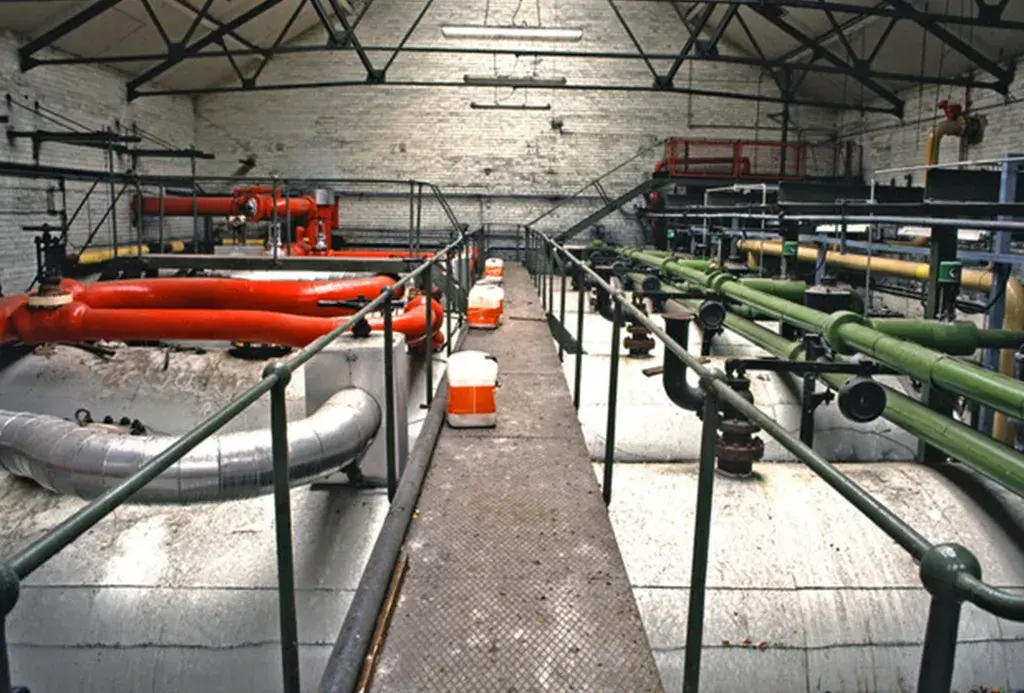
Boiler feedwater quality must follow boiler type, design and operating pressure, steam-purity duty, metallurgy, condensate return, and OEM limits. No single pH, TDS, silica, or oxygen value is safe for every boiler. Establish a written control envelope for makeup, feedwater, boiler water, steam, and condensate, with a defined response for every deviation.
Last technically reviewed: 30 July 2026.
Why boiler type and pressure change chemistry limits
Tolerance for dissolved solids, silica, oxygen, and condensate contamination generally tightens as pressure and temperature rise. Water-tube boilers also have high steam-release rates per unit surface and often include superheaters, so small carryover events can deposit contaminants in the steam path.
Spirax Sarco explains that shell boilers generally tolerate higher TDS, while water-tube boilers become less tolerant as pressure rises and may operate up to about 150 bar(g). Vendor tables are therefore screening tools only; the boiler OEM, turbine/process user, and site treatment program must define the operating limits.
| System condition | Feedwater implication | Controlling document |
|---|---|---|
| Low/medium-pressure shell boiler without a superheater | Softening and internal treatment may be sufficient when makeup TDS, condensate return, load, and steam duty allow | OEM manual, water-treatment specialist recommendation, site blowdown and residual targets |
| Water-tube or higher-pressure boiler | Purity requirements tighten; carryover, silica, sodium, and deposits become more critical | Boiler OEM, superheater/turbine requirements, demin/RO/condensate-polishing specification |
| Low condensate return or high makeup TDS | Salt concentration and blowdown rise; softening does not reduce TDS | Water balance, makeup analysis, concentration target, RO or demineralizer study |
| Condensate exposed to process leaks | One leak can return oil, organics, hardness, acid, or salts to the boiler | Condensate risk matrix, diversion alarms, return-to-feedtank limits, isolation procedure |
| Steam contacts food or a sensitive process | Chemical selection and carryover must suit the end use | Process requirements, product SDS/approval, OEM, and company standard |
Published numbers are references, not universal limits
The values below show why every number needs context. Do not copy them into a setpoint before checking pressure, boiler type, OEM limits, treatment regime, analytical method, and steam use.
| Published figure | Source context | Safe use |
|---|---|---|
| pH 10.5–12.0 | Spirax Sarco summarizes BS 2486 guidance for shell-boiler water at 10 bar and notes that lower pH can apply at higher pressure | Treat it as evidence that pressure changes the target—not as a universal feedwater or boiler-water limit |
| Boiler-water TDS around 2,000 ppm for very small shell boilers up to 3,500 ppm for larger units | Spirax Sarco’s TDS-control guide gives this conventional range subject to load and other conditions | Use for screening only; the same source directs users to the boilermaker/OEM for specific recommendations |
| Dissolved oxygen typically <7 ppb | Spirax Sarco’s pressurized-deaerator guide cites this level for high-pressure water-tube boilers and superheated-steam plants | Do not treat it as a guarantee for every deaerator; define the sample point, method, temperature, and OEM limit |
| 8 ppm sodium sulfite per 1 ppm dissolved oxygen plus an example 4 ppm reserve | Spirax Sarco’s feedtank guide explains stoichiometry and an open-loop low/medium-pressure example | This is a chemical relationship and example, not a finished-product dose; check active strength, catalyst, target residual, and use restrictions |
Write the full basis beside every value: mg/L as CaCO3, mg/L as SiO2, µS/cm at a stated reference temperature, ppb O2, and bar(g) or bar(a). Many bad decisions begin with a correct number stripped of its unit basis, sample point, or temperature.
Sampling map from makeup water to condensate
An unrepresentative sample produces bad dosing and blowdown decisions. Use permanent labeled points, a suitable sample cooler, defined flushing time, and a safe procedure for hot pressurized water.
| Sample point | Core parameters | Decision supported |
|---|---|---|
| Raw/makeup water before treatment | pH, turbidity/TSS, hardness, alkalinity, TDS/conductivity, silica, iron, manganese, chloride, source-specific organics | Pretreatment capacity, fouling risk, regeneration, and seasonal variation |
| After softener/RO/demineralizer | Hardness leakage, conductivity, silica, sodium where critical, SDI/turbidity for RO | Resin breakthrough, permeate quality, polishing need, and feedtank interlock |
| Feedtank/deaerator outlet | pH, conductivity, hardness, dissolved oxygen, temperature, iron/copper where relevant | Deaeration performance, contamination ingress, and oxygen-scavenger need |
| Boiler feedline after dosing | pH, conductivity, program residual, dissolved oxygen as required | Mixing and actual dose before the boiler |
| Boiler water at a representative point | pH, conductivity/TDS, alkalinity, phosphate/sulfite or other residual, silica, chloride, iron | Blowdown, chemical adjustment, and deposit/carryover risk |
| Steam/condensate return | Conductivity/cation conductivity where available, pH, iron, copper, hardness, sodium, oil/TOC based on process risk | Accept/divert/discard condensate; investigate carryover and corrosion |
For boiler-water TDS, Spirax Sarco warns against sampling from a gauge glass, external control chamber, or close to the feedwater inlet because the result may not represent the boiler. A hot sample can also flash, injure the operator, and concentrate the result; use an approved sample cooler and OEM procedure.
Prove the data before changing blowdown or dose
Classify every result as trusted, cross-check required, data quarantined, or operational escalation. Do not change blowdown or chemical dose from a single number whose sample point, temperature, units, calibration, and load condition are unknown. Auditable data always retain the collection and verification context.
| Control data | Evidence needed to trust it | Warning that the result is suspect | Action before correcting the process |
|---|---|---|---|
| Online pH or conductivity | Clear instrument and point tags, documented temperature compensation, valid calibration, stable sample flow, and agreement with a grab sample | Value jumps when the flow cell is dry or dirty, drifts after calibration, or differs materially from the reference meter | Clean and condition the flow cell, repeat the standard check, then take a parallel sample |
| Hardness after a softener/demin train | Correct downstream point, flushed line, valid reagents/blank, and a reproducible result | One isolated positive, sample colour masks the endpoint, or the valve is connected to another line | Hold product water where the risk warrants it; confirm with a second method or laboratory before declaring breakthrough |
| Silica, alkalinity, or programme residual | Recorded method, unit basis, instrument range, blank/standard, analysis time, and chemical species being measured | Ion and compound bases are confused, result falls outside method range, or residual rises without matching chemical use | Verify the calculation basis and chemical-feed balance; dilute or repeat under the approved method |
| Dissolved oxygen | Sample cooler and tubing minimise air ingress, point after the deaerator is clear, instrument is conditioned, and operating temperature/pressure are logged | Visible bubbles, open sampling, slow flow, or no response when deaerator conditions change | Repair the sample route and prove the method before increasing oxygen scavenger |
| Condensate iron, copper, oil, TOC, or conductivity | Source header, time, process load, bottle/preservation, and blank are traceable to the method | A combined sample hides the affected header, or the bottle/point introduces contamination | Separate the suspect header, collect confirmation samples, and apply the facility’s accept-hold-divert logic |
| Blowdown, makeup, and chemical-feed flow | Meter or volumetric calibration has a date, range, totaliser, and a water/chemical balance that closes reasonably | Pump stroke changes without a tank-use change, or makeup/blowdown ratio conflicts with chemistry trends | Test actual output at operating backpressure; inspect valves, leakage, overflow, and meter accuracy |
Apply a method-quality gate before accepting a number
Release a result for operating use only after the method proves that the sample, measurement range, and quality checks are valid. ASTM D3370-25 identifies sample point, sampling-system design, timing, frequency, and sample integrity as parts of representativeness. It does not set boiler control limits; the analytical method, OEM, and facility laboratory procedure still define acceptance.
| QA or method finding | Data status | Disposition before a process decision |
|---|---|---|
| Result is below the reporting limit | Do not convert it to zero | Confirm that the reporting limit is below the warning/action limit; otherwise use a more sensitive method |
| Result is beyond the calibrated range | Quarantine | Dilute or repeat within an approved range/method; do not extrapolate the curve |
| Blank fails the method criterion | Quarantine the related data batch | Find bottle, reagent, rinse-water, tubing, or environmental contamination; repeat blank and sample |
| Standard check or control sample fails | Quarantine data since the last passing check | Inspect reagents, calibration, drift, and instrument; define which samples require reanalysis |
| Duplicate misses the method/site precision criterion | Cross-check | Check homogeneity, flushing, aliquot technique, interference, and analyte stability before averaging |
| Holding time, preservation, or sample-point identity is invalid | Not fit for a controlling decision | Resample; do not assign false precision to data whose integrity is lost |
A minimum release record carries sample ID, point, time, load condition, temperature, method and revision, instrument, range, blank/standard/duplicate results, dilution, analyst, reviewer, and trusted–cross-check–quarantined–escalated status. If the reporting limit is higher than the OEM action limit, “not detected” does not prove safe water; the method cannot yet support that decision.
Record the data-quality status beside the process value in the operator log. When an online sensor and manual result disagree, do not choose the more convenient number: investigate sample-line residence time, temperature, contamination, method, calibration, and load change. Retain relevant samples and record who released quarantined data.
A utilities laboratory may serve several systems, but their control envelopes must not be mixed. For an evaporative circuit, use the cooling-tower water-quality control-envelope guide; boiler limits remain specific to their sample point, pressure, OEM, and steam duty.
Select pretreatment from the actual feedwater problem
Selection starts with a complete analysis, boiler pressure, steam duty, and condensate-return percentage. Do not install a softener for a TDS problem or RO for condensate contamination without testing the root cause.
| Dominant condition | Option to evaluate | Decision boundary |
|---|---|---|
| High hardness, acceptable TDS, shell boiler | Ion-exchange softener | Softening exchanges Ca/Mg for Na but does not lower TDS; monitor leakage and regeneration |
| High TDS, alkalinity, or silica | Reverse osmosis, dealkalization, or demineralizer | Check recovery, reject disposal, pretreatment, silica specification, degassing, and polishing |
| High steam purity or water-tube/high-pressure service | Two-pass RO, demineralization, mixed bed/EDI, and condensate polisher as specified | Design from OEM and steam-user limits, not a generic train |
| High dissolved oxygen | Feedtank heating, deaerator, correct venting, air-ingress repair, and oxygen scavenger | Chemistry cannot compensate for a failed deaerator; measure DO at the correct point and method |
| High iron/copper in condensate | Correct pH/amine regime, inspect corrosion source, polish or divert condensate | Protect mixed metallurgy; do not return contaminated condensate solely to save heat |
| Sudden oil/organic or hardness contamination in return | Isolate heat-exchanger/process leak, automatic diversion, drain, and investigate | Hold return until evidence meets the site’s acceptance criteria |
Build a usable control envelope and alarm plan
A control envelope should state target, warning level, action limit, test method, sample point, frequency, owner, and response. Maintain separate tables for makeup, feedwater, boiler water, steam, and each high-risk condensate header.
- Start with maximum and minimum limits from the OEM and the most sensitive steam user.
- Add treatment-program targets and product residuals based on site data.
- Place the warning level inside the action limit so operators have time to respond.
- Define online versus laboratory tests, calibration, and cross-check frequency.
- Connect alarms to condensate hold/diversion, blowdown adjustment, pretreatment correction, or load reduction.
- Review the envelope after changes to pressure, raw material, makeup source, condensate return, chemical, or equipment.
Avoid changing three variables at once. A rise in boiler-water conductivity can come from the blowdown valve, feedwater TDS, chemical addition, or contamination; diagnosis needs trends and a balance, not one reading.
Boiler-water chemistry alarm response checklist
Boiler safety and OEM instructions take priority over production. When the condition can cause false level, foaming, carryover, overheating, or rapid corrosion, involve the responsible boiler engineer and follow the site’s derating or shutdown procedure.
- Confirm point, unit, temperature compensation, calibration, and grab-sample result.
- Check pressure/load, feed flow, blowdown position, makeup percentage, and condensate return.
- Review softener/RO/demin differential pressure, regeneration, conductivity, hardness leakage, and alarms.
- Check deaerator temperature/pressure/vent and dissolved oxygen; do not only raise scavenger dose.
- If condensate changes, divert the suspect header and trace the leaking heat exchanger or process.
- Verify dosing-pump stroke/flow, tank level, solution strength, injection quill, and check valve.
- Retain samples, log actions, and complete root-cause review before restoring normal setpoints.
PT Beta Pramesti Asia provides boiler water treatment chemical programs, Betagard boiler chemicals, and boiler chemical cleaning service when deposits need an offline assessment. For injection hardware or replacement components, see Watermart’s water-treatment dosing pumps.
Data required for a boiler-program review
Send boiler type and OEM, steam capacity, design/operating pressure, tube material, superheater or turbine duty, makeup and condensate-return percentages, analysis at every sample point, 3–12 months of online trends, chemical targets/residuals, blowdown rate, chemical consumption, alarm logs, deposit/corrosion inspection, and process changes. These inputs separate pretreatment, deaeration, dosing, blowdown, carryover, and condensate-contamination problems.