

Industry: Oil_and_Gas | Process: Midstream_
Short answer: pipeline hydrotest water for a 10⁴–10⁶ m³ project must be managed as a temporary water system. Calculate volume, secure a permitted source, control solids and corrosion risk, reuse water between compatible sections, then treat and test the final drain-down before release. Treatment decisions follow source quality, pipe metallurgy, test chemicals, and discharge limits.
For Indonesian projects, start the permit file against UU No. 17/2019 on Water Resources, PP No. 30/2024 on water resources management, and PP No. 22/2021 on environmental protection and water-quality management (peraturan.bpk.go.id, peraturan.bpk.go.id, peraturan.bpk.go.id).
Last technically reviewed: 3 August 2026.
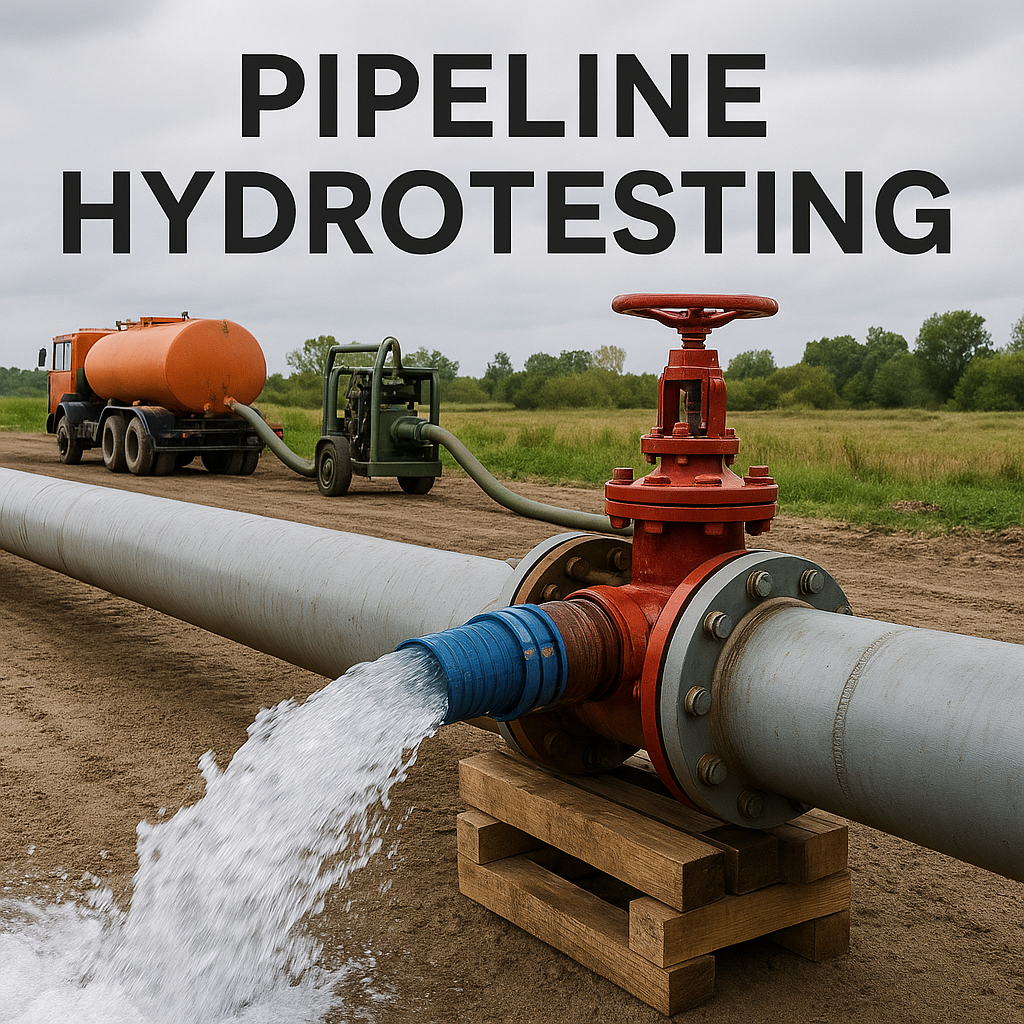
Pipeline hydrotesting fills and pressurizes a pipeline with water to verify integrity. In a 10⁴–10⁶ m³ scenario, demand ranges from tens of thousands to millions of cubic metres. That volume must be compared with community supply, agriculture, ecological flow, tank storage, trucking capacity, temporary treatment capacity, and the discharge window.
Environmental guidance is blunt that operators “should not naively assume” a project can pump from a lake and return the water without prior multi‑agency approvals (pgjonline.com). Practically, that means planning many months in advance for water‑permit applications, building environmental offsets if needed, and possibly agreeing to seasonal limits or minimum‑flow requirements.
Permitting and allocation constraints
A pipeline operator must secure withdrawal permits from national or regional water agencies and demonstrate that public supplies and ecological flows are not harmed (indonesiawaterportal.com). Regulators commonly require that farms and communities have first access, and may mandate minimum residual flows. U.S. pipeline guidance reinforces that multi‑agency approvals are standard for lake or stream withdrawals (pgjonline.com).
Use this decision table before committing to a source or a test-section sequence:
| Decision point | What to calculate or test | Practical threshold for action |
|---|---|---|
| Fill volume and fill rate | Volume = 0.785 × internal diameter² × length; compare the result with pump rate, tank/pond volume, and permitted withdrawal rate. | If the permitted source cannot support the fill window, split test sections, add temporary storage, or move to trucked/remote transfer supply. |
| Source quality | pH, conductivity/TDS, TSS or turbidity, chloride, hardness, oil sheen, residual chlorine if using PDAM or reclaimed water. | High solids need screening, clarification, sand filtration, or UF before filling; high chloride or seawater needs a corrosion-inhibitor compatibility review. |
| Reuse potential | pH, turbidity, conductivity, oil sheen, rust load, and chemical residual after each section. | Reuse from cleaner/newer pipe into dirtier/older sections; stop reuse when solids, oil, or incompatible residuals rise. |
| Discharge proof | Permit limit, receiving-water sensitivity, treatment-train capacity, field checks, and lab sample plan. | Hold water in tanks, ponds, or frac tanks until field checks and lab results support discharge or reuse. |
Surface and groundwater withdrawal
The most straightforward source is a nearby river, lake, or aquifer, supplying very large volumes at low marginal cost—if permits are in hand. Offshore and coastal projects have filled with seawater: Nord Stream’s pipelines each required about ~1.2×10⁶ m³ of seawater for testing (www.nord-stream.com), and Saudi Aramco’s Rabigh lines tapped Red Sea water with corrosion inhibitors (studylib.net).
Inland projects in Indonesia would typically pump fresh raw water from a stream or well, with regulators again prioritizing other users. Source water should be low in chlorides and suspended solids to avoid corrosion and blockage. When rivers are turbid or groundwater is mineral‑rich, additional filtration or chemical conditioning is often required; in such trains, continuous debris removal via an automatic screen can protect downstream equipment.
To reduce suspended solids before filling, operators commonly rely on dual‑media filtration; a sand bed such as sand/silica filtration is a typical choice. Where coagulation is needed to settle fines, aluminum coagulants like PAC are dosed upstream, typically metered with a dosing pump to control chemical feed.
After the test, water is routinely contaminated with rust, sediments, and organics—requiring treatment before discharge (xylem.com). Primary clarification in a sedimentation unit such as a clarifier is a common first step prior to any permitted release.
Where seawater is used, chemical protection is standard practice; corrosion mitigants such as a corrosion inhibitor are dosed to limit damage during the pressure hold (studylib.net).
Trucking and temporary transfer logistics
If no local source is viable, projects truck in potable or minimally treated water (e.g., municipal PDAM supply) or build a temporary transfer line from a distant reservoir. The upside is predictable, high‑quality water that bypasses extraction permits at the site—though permits still apply at the source.
The downside is scale. A 600 mm internal-diameter pipe holds about 283 m³ per km; filling 50 km needs roughly 14,100 m³ before allowances for pigging water, dead legs, storage heel, flushing, or retesting. At 25–35 m³ per truck, that is about 400–570 tanker trips. Moving 50,000 m³ still implies roughly 1,400–2,000 trips and can take many weeks. In rugged or remote parts of Indonesia, trucking may be the only option, but it can dominate schedule, road access planning, and carbon footprint.
A cost review should treat trucking as a premium option because every cubic meter carries vehicle capacity, driver time, loading, queueing, road access, and fuel, not only the water tariff. Mitigations include temporary on‑site storage ponds to allow continuous filling and deploying high‑capacity water wagons or multiple trucks concurrently. If tanker water is drawn from a protected reservoir or well, the operator must still ensure the source is permitted; use of treated PDAM water generally incurs normal utility tariffs.
Reclaimed water and effluent reuse
A growing alternative is to reuse treated effluent from a nearby municipal treatment plant or industrial facility. In principle, this reduces fresh‑water demand and disposal issues because the water was already headed for discharge. In practice, using effluent still requires a water‑use permit, and quality must meet hydrotest standards.
Reclaimed water can carry nutrients, suspended solids, or residual chlorine, so further conditioning is common. For solids control, pressure‑driven membranes such as ultrafiltration are used as a polishing step ahead of the fill. Chlorine residuals are addressed with a dechlorination agent to protect the pipeline metallurgy and seals. If hardness is elevated, a softener is applied to prevent scaling during the hold period.
Starting quality still matters. Inline particulate control with a cartridge filter helps keep fines from depositing in low‑velocity pockets. In Indonesia, a practical setup might pipe tertiary‑treated WWTP effluent into a hydrotest manifold, sample to confirm low conductivity and low chloride, and proceed under the same environmental discharge standards applied to the plant. One industry source notes hydrotest water commonly becomes laden with rust and solids during the test (xylem.com), so beginning with “waste” water can align with pollution‑control permits.
The limitations are volume—a municipal plant may only produce a few thousand m³/day—and timing, since effluent availability might not match a fill schedule. Reuse is strongest when the effluent source is close to the route, the owner can guarantee daily flow, and the quality envelope is narrow enough for a simple polishing train.
Reuse sequence between test sections
Reuse saves the most water when it is sequenced deliberately instead of improvised after the first section drains. The usual rule is to move water from the cleanest, newest, or lowest-risk section into the next compatible section, then send the final drain-down to treatment.
| Reuse step | Field action | Hold point |
|---|---|---|
| Baseline source sample | Sample the source before filling; record pH, conductivity, turbidity/TSS, chloride, hardness, and any disinfectant residual. | Do not dose corrosion inhibitor, biocide, or dechlorination chemistry until the source quality and pipe metallurgy are known. |
| First fill and pressure hold | Filter during fill and keep the fill velocity low enough to avoid mobilizing excess debris. | If the section returns heavy rust, oil sheen, or high turbidity, divert to treatment instead of reusing it directly. |
| Transfer to next section | Pump through screen or bag filtration, then into a compatible section with similar material and cleanliness. | Retest pH, conductivity, turbidity, and oil sheen at each transfer point. |
| Final reuse decision | Compare field checks with the next section’s quality requirement and chemical compatibility. | Stop reuse when carryover threatens corrosion, scaling, biological growth, or the discharge permit. |
| Final drain-down | Route water to equalization, oil removal, clarification, filtration, carbon/dechlorination, and sampling as needed. | Release only after permit-required parameters are documented. |
Drain-down capacity, storage, and water reconciliation
Size the drain-down package from the volume actually transferred, the available window, daily treatment hours, and the peak inflow pattern. Average flow alone is not enough: the project must also store the temporary difference between drain-down and treatment rates, backwash periods, sampling holds, and water that remains inside the pipeline and temporary tanks.
Keep three calculations separate:
average treatment flow (m³/h) = drain-down volume (m³) ÷ [days × operating hours per day];minimum equalization volume = maximum cumulative difference between drain-down inflow and treated outflow; andunreconciled water = incoming water + opening inventory − reused transfers − treated/released water − closing inventory − measured waste streams.
This worked example uses the 14,100 m³ fill volume of a 600 mm internal-diameter pipeline section 50 km long. It excludes manifolds, flushing, pigging, retesting, and tank heels.
| Drain-down window | Treatment operating hours | Required average treatment flow | Check before releasing the capacity basis |
|---|---|---|---|
| 3 days | 24 h/day | 196 m³/h | Confirm transfer pumps, outage storage, power, backwash demand, and the emergency route |
| 7 days | 24 h/day | 84 m³/h | Test whether equalization can absorb the peak release from each pipeline section |
| 7 days | 20 h/day | 101 m³/h | Account explicitly for four non-producing hours instead of relying on nameplate capacity |
| 14 days | 24 h/day | 42 m³/h | Confirm that permits, storage, and water quality allow the longer holding period |
These are mathematical average flows, not final design capacities. Capacity allowance, redundancy, and turndown must follow the actual drain-down profile, water characteristics, backwash demand, unit availability, and permit conditions. If a section drains at 300 m³/h for several hours while treatment accepts 100 m³/h, storage must come from the hourly cumulative curve; dividing pipe volume by the total window hides that peak.
Close the water inventory for every section and day. At minimum, log the source meter, opening and closing tank volumes, transfer to the next section, treatment inflow, filtrate or effluent released, backwash/sludge water, and meter corrections. Hold an unexplained difference for leak, bypass, overflow, or reading-error investigation before claiming that the reuse and discharge objectives were achieved.
Temporary treatment train and discharge testing
Treat the discharge package as a temporary water or wastewater plant. The exact train depends on source water, pipe age, test additives, and receiving-water sensitivity, but the operating logic is consistent:
| Stage | Purpose | Typical Beta handoff |
|---|---|---|
| Debris and trash removal | Protect pumps, valves, and downstream filters from leaves, scale flakes, weld debris, and construction grit. | Automatic screen or manual screen. |
| Oil and gross solids control | Remove free oil, rust, and settleable solids before fine filtration. | Oil removal, PAC, coagulants, and clarifier. |
| Fine filtration and polishing | Lower turbidity/TSS and protect carbon or membrane polishing steps. | Sand/silica filtration, ultrafiltration, and cartridge filter. |
| Residual chemistry control | Remove residual chlorine, color, organics, or treatment additives before reuse or discharge. | Activated carbon, dechlorination agent, and water-wastewater chemicals. |
| Pipe protection during hold | Control oxygen, seawater chloride risk, or microbiological activity when the hold period is long. | Oilfield chemicals and corrosion inhibitor, selected after metallurgy and discharge limits are checked. |
Before discharge, keep a checklist that can survive audit: source approval, withdrawal volume, additive log, transfer/reuse log, pH, TSS or turbidity, oil and grease, conductivity/TDS, residual chlorine if applicable, metals if the line is old or corroded, and any project-specific permit parameters. For independent confirmation of source water or treated drain-down quality, send samples to A3 Laboratories water and wastewater testing before release.
Practical numbers and timelines
Estimating fill early is critical. Use the internal diameter, not the nominal outside diameter, then add allowances for manifolds, temporary tanks, pigging water, line flushing, and retesting.
| Internal diameter | Approximate fill volume per km | Approximate fill volume for 50 km |
|---|---|---|
| 300 mm | 71 m³/km | 3,500 m³ |
| 600 mm | 283 m³/km | 14,100 m³ |
| 900 mm | 636 m³/km | 31,800 m³ |
| 38 in / 965 mm | 732 m³/km | 36,600 m³ |
License applications for withdrawals may take months, and Indonesian projects now need to check both UU No. 17/2019 and PP No. 30/2024 for water-resource management context (peraturan.bpk.go.id, peraturan.bpk.go.id). Case studies underscore the scale—Nord Stream’s test volumes were ~1.2×10⁶ m³ per line (www.nord-stream.com).
Regardless of source—surface water, trucked supply, or reclaimed effluent—post‑test water quality and disposal must meet permit limits under the applicable environmental approval and water-quality rules. If contaminants exceed thresholds, further treatment is required prior to discharge (xylem.com).
Source references and guidance
Current Indonesian regulation starts with UU No. 17/2019 on Water Resources, PP No. 30/2024 on Water Resources Management, and PP No. 22/2021 on environmental protection and water-quality management (peraturan.bpk.go.id, peraturan.bpk.go.id, peraturan.bpk.go.id). Environmental compliance guidance highlights that stream withdrawals require multiple approvals (pgjonline.com). Industry cases illustrate sourcing choices—Nord Stream’s seawater testing approach (www.nord-stream.com) and Saipem/Aramco’s Rabigh lines using local seawater with inhibitors (studylib.net). Technical notes emphasize that hydrotest water can pick up rust and solids, guiding treatment and disposal choices (xylem.com).